Locations:





$10.6M award to help compare escalation with early highly effective treatment
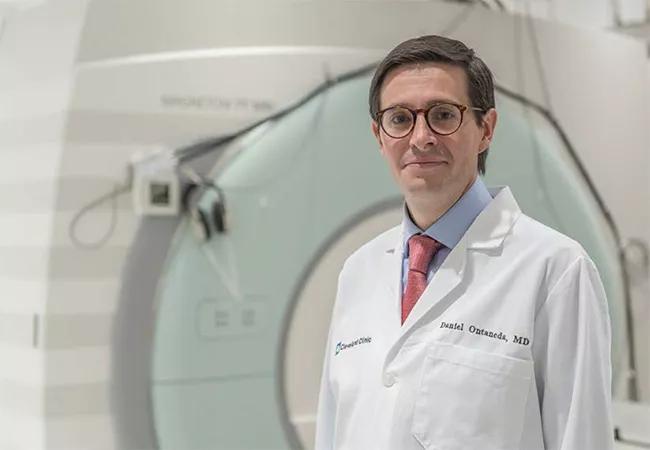
Image content: This image is available to view online.
View image online (https://assets.clevelandclinic.org/transform/399497ca-1709-4ae9-96c7-b3d60784cc13/17-NEU-4267-Ontaneda-650x450_jpg)
17-NEU-4267-Ontaneda-650×450
Escalate or hit hard early? That’s the dilemma that confronts neurologists and patients with relapsing-remitting multiple sclerosis (RRMS) when they’re deciding on a disease-modifying treatment (DMT) strategy.
Advertisement
Cleveland Clinic is a non-profit academic medical center. Advertising on our site helps support our mission. We do not endorse non-Cleveland Clinic products or services. Policy
The unfortunate reality is that no evidence currently exists comparing these DMT approaches in a head-to-head trial. Cleveland Clinic neurologist Daniel Ontaneda, MD, is leading a team of clinician-researchers who want to change that — and their efforts have just received a tremendous boost with a $10.6 million funding award from the Patient-Centered Outcomes Research Institute (PCORI).
The funded project will directly compare the two DMT strategies as defined below:
The project will compare these strategies by using MRI to measure changes in brain volume, a predictor of long-term disability of high interest to individuals with MS, and by monitoring patient-reported outcomes. It will do so through an innovative multicenter study design combining a randomized controlled trial involving 400 patients and an observational cohort of an additional 400 patients. All participants will be treatment-naïve patients with RRMS recruited from the outpatient MS practices of eight sites in the United States and eight sites in the United Kingdom.
Advertisement
“It’s essentially a test of two philosophical approaches to the treatment of RRMS, beyond just a comparison of individual medications,” says Dr. Ontaneda, of Cleveland Clinic’s Mellen Center for Multiple Sclerosis Treatment and Research, the project’s principal investigator. “Discussions with our patients almost inevitably come around to the lack of comparative data between these approaches. We wanted to fill that data gap for patients.”
The project’s emphasis on patients’ real-world priorities was instrumental in the research team’s decision to apply for a PCORI award, explains Dr. Ontaneda (shown in photo above in front of Cleveland Clinic’s 7T MRI scanner). That’s because PCORI was authorized by Congress in 2010 as an independent, nonprofit organization to fund research specifically aimed at providing patients, their caregivers and clinicians with evidence-based information to enhance healthcare decision-making.
“Our project aligns well with many PCORI values,” Dr. Ontaneda notes. He cites as one example the selection of minimal entry criteria to ensure the study will include patients who are representative of the general population of people with RRMS.
Another example is the project’s design as a “pragmatic randomized trial.” In addition to randomizing 400 patients to the two DMT approaches in a 1:1 fashion, the project has an observational component to provide additional data. “Up to 400 participants who don’t agree to randomization or are not eligible for randomization for insurance reasons will be able to participate in the observational cohort,” Dr. Ontaneda explains. “PCORI reviewers said they liked this pragmatic combination of both randomized and observational design elements.”
Advertisement
Study participants will undergo the same assessments regardless of cohort, and assessments will focus on how the two DMT approaches compare in terms of slowing brain volume loss, safety, effectiveness and tolerability.
Those assessments are yet another patient-centered aspect of the project. “We’ll ask participants’ perspectives of their MS symptoms, quality-of-life measures and satisfaction around their DMT,” says Dr. Ontaneda. Patients will be monitored for functional progress in areas such as cognition, limb function and eyesight. Treatment-emergent adverse effects will be recorded too, “since patients’ treatment choices are influenced by medications’ perceived risks as well as their potential benefits,” he adds.
The multicenter project spans two nations — the U.S. and the U.K. — since not all of the EHT medications are available for treatment-naïve patients in the U.S.
Cleveland Clinic is the U.S. coordinating site and is responsible for centralized data management and central MRI reading for the overall project. Three Cleveland Clinic sites — in Ohio, Florida and Las Vegas — are among the eight U.S. sites.
The University of Nottingham is the U.K. coordinating site, and its lead investigator, Nikolaos Evangelou, MD, DPhil, is the project’s other principal investigator. Its partnership with Cleveland Clinic in this area stems from a scholarship trip Dr. Ontaneda took to the University of Nottingham during his training, when he forged a collaborative relationship with Dr. Evangelou around DMT approaches. Both institutions also have 7T MRI scanners, which they are increasingly using to gain insights into these questions.
Advertisement
Funding for the five-year project is approved pending completion of a business and programmatic review by PCORI staff and issuance of a formal award contract. Dissemination of results is expected in the second half of 2022.
“In addition to guiding overall treatment philosophy for patients and clinicians, the results should help healthcare payers make more informed decisions on medication coverage, with the overall cost of long-term disability being a key factor,” Dr. Ontaneda says. “This project has the potential to meet many different needs.”
Advertisement
Advertisement

New study advances understanding of patient-defined goals
Testing options and therapies are expanding for this poorly understood sleep disorder
Real-world claims data and tissue culture studies set the stage for randomized clinical testing
Digital subtraction angiography remains central to assessment of ‘benign’ PMSAH

Cleveland Clinic neuromuscular specialist shares insights on AI in his field and beyond
Findings challenge dogma that microglia are exclusively destructive regardless of location in brain

Neurology is especially well positioned for opportunities to enhance clinical care and medical training
New review distills insights from studies over the past decade
 Search