Locations:
Search IconSearch
October 19, 2016/Nursing/Clinical Nursing

Cleveland Clinic ACNO Shares Falls Prevention Tips

Reduce falls through standardization, awareness and more
fall_650x450

By Dana Wade, DNP, RN, CNS-BC, CPHQ, NEA-BC

Advertisement

Cleveland Clinic is a non-profit academic medical center. Advertising on our site helps support our mission. We do not endorse non-Cleveland Clinic products or services. Policy

wade_150x180

Dana Wade, DNP, RN, CNS-BC, CPHQ, NEA-BC

Throughout the years, Cleveland Clinic’s Stanley Shalom Zielony Institute for Nursing Excellence has worked diligently to enhance its falls prevention strategies. Just one year ago, Cleveland Clinic launched a new and highly successful falls prevention steering committee, inclusive of caregivers from dozens of areas throughout the health system – from pharmacy to environmental services.

Cleveland Clinic has a number of standardized falls prevention initiatives, including falls prevention protocols, product resources to assist in preventing falls and assist with patient mobility, screening patients at high risk for falls in the electronic medical record (EMR) system, patient education materials, and caregiver fall risk management education.

The falls prevention steering committee is currently working on several additional prevention initiatives, including implementation of a high fall risk signage change, communication to raise caregiver awareness, reduced fields for reporting patient falls events, and a patient ‘My Safety Plan’ to engage patients and families.

And, thanks to strong leadership and focused caregiver effort, Cleveland Clinic consistently outperforms national benchmarks for areas such as: ‘total falls’ and ‘falls with any injury.’

Throughout all of its work in the area of falls prevention, Cleveland Clinic has realized several lessons learned. Below is a selection of tips that nursing organizations may find helpful when looking for ways to improve falls prevention strategies.

  • Ensure continued awareness among caregivers, the patient and the patient’s family.
    Falls prevention information should be incorporated into admission information for all patients and families with a process for evaluating their understanding of the information. An individualized plan of care designed by the caregiver in collaboration with the patient and family is vital.
  • Create a standardized falls prevention protocol.
    Caregivers need to be familiar with the falls prevention protocol and resources available in their organization.
  • Conduct falls prevention rounding.
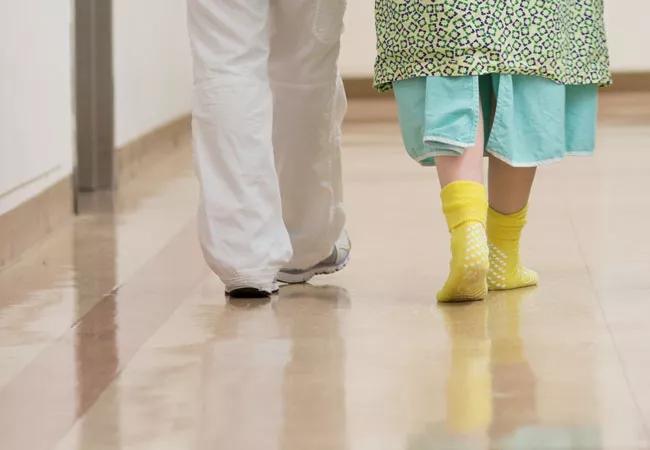
    Emphasizing impactful hourly rounding is highly important. Criteria, such as bed alarms, toileting, yellow non-slip socks and wristbands, should be defined in the falls prevention protocol. Additionally, caregiver teams should meet routinely to allow an opportunity to develop a prevention plan for patients identified as high risk for falls.
  • Visual communication that is intuitive for all caregivers can help keep patients safer. This can include caregiver education on scripting for toileting, the caregiver’s role in falls prevention, high-risk medications, dealing with impulsive patients, how to conduct a post-fall huddle, and more. For example, Cleveland Clinic recently changed its high-risk patient signage to align with the event reporting system icon, a yellow falling man.
  • Always remember the patient environment.
    A safe patient environment is of utmost importance, such as keeping the bed at the lowest level and the call light within reach or ensuring there are call lights and safety rails in bathrooms. Also, consider the patient environment with any new construction projects.
  • Include nursing caregivers in any hospital or health system patient falls committee.
    These committees should be multidisciplinary and include subteams, such as data management, transition of care, screening and identification, education/communication, care environment and medication safety. Nurses should be active participants, serving as a co-chair with a physician or the primary leader of a subteam.
  • Use validated risk assessment tools to identify patients at high risk of falling while in the hospital. As patient complexity increases, nurses as well as other caregivers should be actively involved in evaluating potential screening tools available for falls risk. Caregivers should be aware that these screening tools do not replace critical thinking skills and judgment when designing an individualized plan of care for patients.
  • Ensure the EMR features the option for nurses to consider a patient at high fall risk based on clinical judgment, not just risk score.
  • Ensure shift reports feature an identified ‘falls prevention’ banner that remains present throughout the duration of a patient’s hospitalization.
  • Conduct a falls program gap analysis using evidence from current literature and from resources such as, the Joint Commission Sentinel Alert, Issue 55 and the National Patient Safety Foundation. This document outlines the items that should be in place to have a successful patient falls prevention program.

Advertisement

Dana Wade is the Associate Chief Nursing Officer of Nursing Quality and Practice for the Cleveland Clinic Health System and Cleveland Clinic Main Campus.

Photo credit ©Russell Lee

Advertisement

Related Articles

Patient with sickle cell disease

Unique “Neighborhood” Addresses Needs of Patients With Sickle Cell Disease

Nurses play key role in comprehensive lifetime treatment program
Electronic health record (EHR)

Nursing Teams Leverage Automation to Improve Workflows, Devote More Time to Patient Care

Customized bots improve speed, efficiency by streamlining daily clinical, clerical tasks
Headshots of Woodward and Blankemeier
March 13, 2024/Nursing/Clinical Nursing

Home Care: Moving Beyond the Hospital (Podcast)

Nurses play pivotal role in patients’ ability to recover in the comfort of their own homes
Patient's arm connected to dialysis IV

Emergency Dialysis Criteria Reduce Number of After-Hours Calls for Nurse Specialists

New protocol reduces costs, increases patient and caregiver satisfaction
Head shot of nurse Dena Salamon
February 29, 2024/Nursing/Clinical Nursing

Speaking Up in the Perioperative Setting (Podcast)

Advocating for patient safety is imperative in fast-paced surgical settings
Head shot of nurse Patricia Gilbert
February 23, 2024/Nursing/Wellness

Providing Trauma-Informed Care to Pregnant Patients (Podcast)

M-Power program improves the perinatal experience for people who have survived abuse

Nurse laughing with elderly patient
February 21, 2024/Nursing/Clinical Nursing

What to Consider When Choosing a Wound, Ostomy and Continence Nursing Education Program

Advice for those pursuing a WOC nursing career

Head shot of nurse TC Cairns
February 16, 2024/Nursing/Quality

Caring for Your Community (Podcast)

Veteran nurse shares his experience as a caregiver and community volunteer

Ad