Locations:





An MRI finding does not a diagnosis make

Image content: This image is available to view online.
View image online (https://assets.clevelandclinic.org/transform/4ebaa06d-f1e0-4da1-bfee-0d20a1a37bb2/16-NEU-783-Benzel-650x450_jpg)
16-NEU-783-Benzel-650×450
Advertisement
Cleveland Clinic is a non-profit academic medical center. Advertising on our site helps support our mission. We do not endorse non-Cleveland Clinic products or services. Policy
The Institute of Medicine’s 2011 report, Relieving Pain in America, tells us that one out of three U.S. adults is afflicted with chronic pain.
If you think about it, that’s an earth-shaking observation: How is it that one in three adults in the most advanced civilization in history can succumb to such a demeaning cause of human misery? While there’s no clear answer, the question itself calls for a wholesale rethinking of the healthcare community’s approach to chronic pain.
Chronic pain is not synonymous with chronic pain syndrome. Chronic pain is a pain disorder that has been present for a prolonged period. In contrast, chronic pain syndrome is a constellation of symptoms that includes chronic pain as the foundation on top of which a number of systemic factors become manifest, specifically:
Additional associated factors may include multiple unrelated somatic complaints, history of opiate use and often a history of noncompliance with therapeutic strategies such as weight loss, smoking cessation and exercise programs.
Considering that chronic pain syndrome affects one of three U.S. adults, it must extend beyond the boundaries of spine disorders — in other words, chronic disabling back pain may be common, but not that common.
If one considers the essential elements of chronic pain syndrome (chronic pain, nonrestorative sleep, low energy level and relative inactivity), many other entities fit in the same category. These include chronic temporomandibular joint pain, chronic headache, chronic abdominal pain, chronic pelvic pain, etc. All have the essential elements and many of the associated elements. However, each is “packaged” with different clinical manifestations. What we as physicians see is the wrappings of the package — e.g., chronic back pain, pelvic pain, abdominal pain. Beneath the wrappings lie the fundamental components of chronic pain syndrome (chronic pain, nonrestorative sleep, low energy level and relative inactivity).
Advertisement
The problems associated with chronic pain syndrome stem from the fact that standard acute pain treatments — prescription opiate therapy, operations, nerve/spine blocks and other procedures — do not work. In fact, they often perpetuate the problem and escalate the magnitude of the pain syndrome.
The societal cost of chronic pain syndrome is immense. First, the pain and suffering are immeasurable. Beyond that, the financial burden is profound, with $635 billion spent annually on chronic pain syndromes in the U.S. Yet most of this money does not produce the desired outcome, and it may perpetuate the underlying problem. Unnecessary imaging studies result in the “diagnosis” of anatomical derangements that typically prompt ill-advised procedures and operations or the opiate prescriptions. In turn, these interventions may be expected to worsen, not improve, a clinical and emotional calamity that has disguised itself as a clinical problem linked to an imaging finding.
So what’s the real source of the problem in the emerging epidemic of chronic pain? The answer is wrong diagnosis.
Physicians often make a diagnosis on the basis of an imaging study. Yet an MRI finding of degenerative spondylolisthesis does not a diagnosis make. The diagnosis might be back pain, but if the back pain is chronic and associated with the other essential elements of chronic pain syndrome, the clinical diagnosis is chronic back pain syndrome, not degenerative spondylolisthesis. One is a diagnosis to be treated (chronic back pain syndrome). The other is an imaging finding (degenerative spondylolisthesis).
Advertisement
In cases where a mismatch exists, a pseudoconcordance may be established between imaging and the patient’s complaint that will result in imaging abnormalities being addressed as surrogates for the primary diagnosis when, in fact, the primary diagnosis is chronic back pain syndrome.
For instance, degenerative L4-5 spondylolisthesis (Figure) is a common imaging finding. If such a finding is made in a patient with chronic back pain syndrome, he or she may be treated with ill-advised procedures, operations and opiates rather than having chronic pain syndrome established as the diagnosis and managed accordingly.
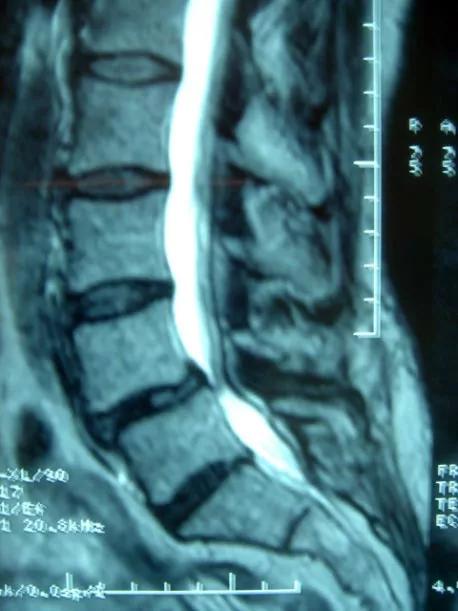
Image content: This image is available to view online.
View image online (https://assets.clevelandclinic.org/transform/bfa5743e-911e-46b1-be6a-851bbfb7bf68/16-NEU-783-Benzel-inset-image-1_jpg)
Figure. An MRI finding of degenerative L4-5 spondylolisthesis does not a diagnosis make.
Yes, the patient complains of back pain, but before assuming concordance between the complaint and the imaging finding, clinicians do well to remember that pain in a patient with chronic back pain syndrome may often be associated with a number of the following:
Such pseudoconcordance between imaging and the clinical picture can lead both physician and patient down a long, tortuous pathway that involves more procedures, operations and medications.
Advertisement
The solution is simple: Make the correct diagnosis and treat accordingly. Chronic back pain syndrome is not best managed by surgery. If diagnosed, it is best managed by a comprehensive multidisciplinary approach by providers who specialize in chronic pain disorders — not by surgically addressing the imaging finding (i.e., degenerative spondylolisthesis).
Physicians should start with the “clinical diagnosis” and only secondarily see if this matches the imaging findings. Until such becomes commonplace, the chronic pain epidemic will rage on.
Dr. Benzel (benzele@ccf.org) is a neurosurgeon in Cleveland Clinic’s Center for Spine Health.
Advertisement
Advertisement

New study advances understanding of patient-defined goals

Testing options and therapies are expanding for this poorly understood sleep disorder
Real-world claims data and tissue culture studies set the stage for randomized clinical testing
Digital subtraction angiography remains central to assessment of ‘benign’ PMSAH

Cleveland Clinic neuromuscular specialist shares insights on AI in his field and beyond
Findings challenge dogma that microglia are exclusively destructive regardless of location in brain
Neurology is especially well positioned for opportunities to enhance clinical care and medical training
New review distills insights from studies over the past decade
 Search