Locations:





Learn the fundamentals of spine surgery and decision-making
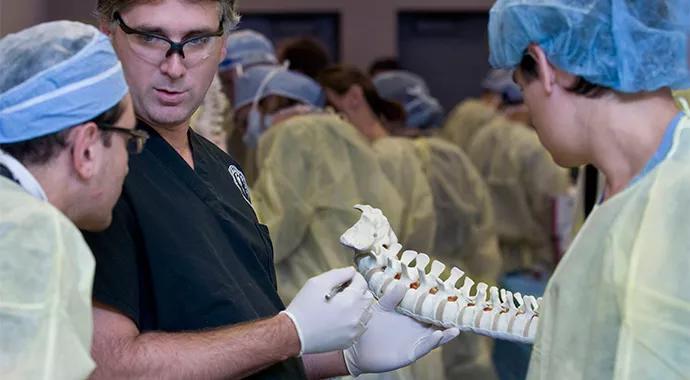
Image content: This image is available to view online.
View image online (https://assets.clevelandclinic.org/transform/c6377fbc-1964-4a2a-a87c-983fe6a58e2e/Spine-Camp-690x380_jpg)
Spine-Camp-690×380
Spine Camp is back.
Advertisement
Cleveland Clinic is a non-profit academic medical center. Advertising on our site helps support our mission. We do not endorse non-Cleveland Clinic products or services. Policy
Cleveland Spine Review: Hands-On 2015, presented by Cleveland Clinic’s Center for Spine Health, will be underway July 14-21, 2015, at Cleveland Clinic Lutheran Hospital.
Since the 1990s, Cleveland Spine Review has been a much anticipated event, drawing up to 150 neuro and orthopedic spine surgeons from across the globe. Cleveland Clinic’s Center for Spine Health assembled a premier faculty of experts from Cleveland Clinic and other top institutions around the world who will offer diverse perspectives.
This year, Cleveland Spine Review returns with its unique format of interactive labs, case studies and one-on-one discussions on techniques and approaches that provide participants the opportunity to practice what they learn right away. Participants will study surgical techniques and strategies for a range of procedures, including occipitocervical, cervical, thoracic and lumbar fixation techniques. Complex surgical exposures in all regions of the spine are emphasized.
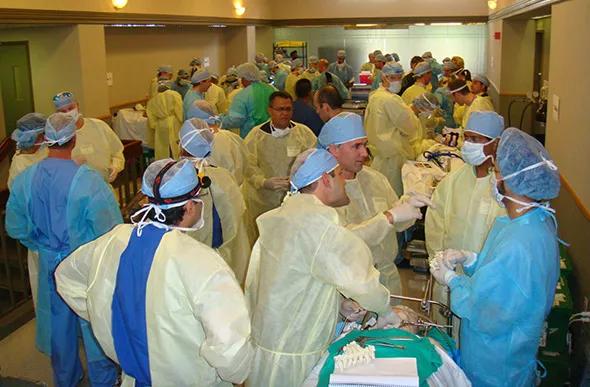
Image content: This image is available to view online.
View image online (https://assets.clevelandclinic.org/transform/359f18cf-3021-45a3-a223-8d788453bbbe/Spine-Camp-inset3_jpg)
The intensive course emphasizes the fundamentals of spine surgery and the surgerical decision-making process. The course examines the multiple adjuncts to surgery, including soft tissue and bone retractors and distractors, minimally invasive surgical techniques, spinal implants and dissection tools. Nonoperative strategies also are emphasized.
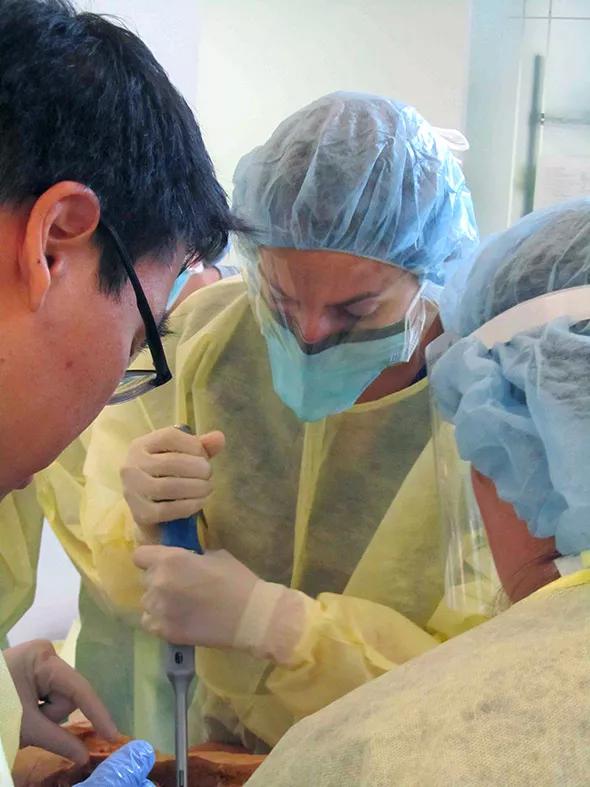
Image content: This image is available to view online.
View image online (https://assets.clevelandclinic.org/transform/c45c620c-09d3-43e4-a37a-ed39554f0470/Spine-Camp-inset1_jpg)
The Art Steffee Honored Guest Lecturer this year is Zoher Ghogawala, MD, FACS, the Charles A. Fager Chair of Neurosurgery in the Lahey Clinic in Burlington, Mass.
In addition to the full agenda of lectures and interactive labs, participants also are invited to attend add-on didactic lectures “Management of Spine Tumors” on July 14 and 15.
Advertisement
Participants can look forward to:
Nurses, advanced practice nurses, physician assistants, physiatrists and other medical spine specialists also have a seat at the table. Special sessions for nonsurgeons will be held at noon on the first day of the Spine Camp to prepare for the upcoming content.
A variety of nonsurgical breakout sessions including a cadaver laboratory will offer unique, multifaceted learning experiences. There will be opportunities to learn side by side with surgeons in didactic sessions.
Click here for details and registration.
These activities have been approved for 53.75 physician AMA PRA Category 1 Credit™.
Advertisement
Advertisement

New study advances understanding of patient-defined goals
Testing options and therapies are expanding for this poorly understood sleep disorder
Real-world claims data and tissue culture studies set the stage for randomized clinical testing
Digital subtraction angiography remains central to assessment of ‘benign’ PMSAH

Cleveland Clinic neuromuscular specialist shares insights on AI in his field and beyond
Findings challenge dogma that microglia are exclusively destructive regardless of location in brain
Neurology is especially well positioned for opportunities to enhance clinical care and medical training
New review distills insights from studies over the past decade
 Search