Locations:





Project draws $1.6M to leverage telemedicine to create medical home, ease transition to adult care
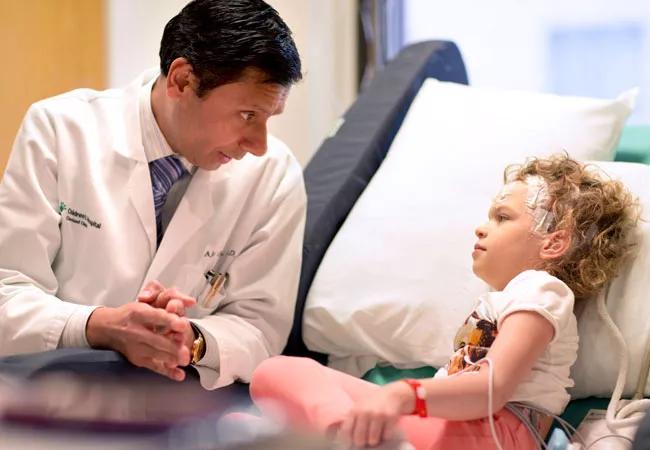
Image content: This image is available to view online.
View image online (https://assets.clevelandclinic.org/transform/9bbd77b2-8783-4038-bd2c-516f085190e3/19-NEU-3981-pediatric-epilepsy-650x450_jpg)
19-NEU-3981-pediatric-epilepsy-650×450
To the extent that healthcare’s future lies in patient engagement, care coordination and telemedicine, Cleveland Clinic is charting a course for what that future may look like in the subspecialty of pediatric epilepsy. And it’s doing so with renewed grant support from the federal Health Resources & Services Administration (HRSA) to a clinical team in Cleveland Clinic’s Epilepsy Center as well as six Cleveland Clinic pediatric primary care sites and adult internal medicine providers.
Advertisement
Cleveland Clinic is a non-profit academic medical center. Advertising on our site helps support our mission. We do not endorse non-Cleveland Clinic products or services. Policy
The grant provides $1.6 million through August 2023 for Project IMPACTT (Integrating Mobile Provider Access for Telemedicine and Transition). The new funding extends an initial three-year HRSA award that ended in August 2019.
“Project IMPACTT is increasing access for children and youth with epilepsy to coordinated, quality healthcare in a patient- and family-centered medical home,” says project lead Tatiana Falcone, MD, a child and adolescent psychiatrist with Cleveland Clinic’s Center for Behavioral Health and Epilepsy Center. “We are pursuing a multipronged approach to create models of excellent telehealth services for this pediatric population with multiple healthcare needs.”
Project IMPACTT’s major goals include enhancing care coordination, social support, education, and patient and family engagement with the assistance of telehealth and other digital technologies. Activities center on the following areas:
Improving access to healthcare services. Using face-to-face digital platforms such as Cleveland Clinic’s Express Care® Online app, parents can access healthcare for their child from home. The availability of teleconsultation with a patient’s epilepsy specialist also offers another important benefit, particularly for families who live far from the Epilepsy Center. Dr. Falcone calculates that the free telehealth services covered by the grant can save families $600 per visit or more after factoring in transportation, lodging and work time lost. These services also can potentially improve continuity of care, with patients continuing to be well monitored despite now only having to come for appointments once a year.
Advertisement
Enhancing family engagement in healthcare. The medical home model, already underway at the Epilepsy Center through the first Project IMPACTT grant, is being extended to the six pediatric sites to “promote a health system that patients and families know they can rely on whenever they need help and wherever they are,” says Dr. Falcone.
A care coordinator works with families to help them cope with a new epilepsy diagnosis and access services and information. Project IMPACTT has also established online support groups and education programs for families. A series of free webinars delivered by Epilepsy Center specialists helps families navigate the challenges of epilepsy, from new diagnosis to seizures in toddlers, medications, surgery, school issues and transitioning from pediatric to adult care.
Easing transition to adult care. Project IMPACTT is facilitating transition readiness for patients and providers at the pediatric sites and in adult internal medicine, using resources from the Got Transition™ organization and tools embedded in the Epic electronic record.
The transition from pediatric to adult care can be intimidating for any adolescent but is particularly challenging for those with special medical needs, Dr. Falcone explains. “Starting when patients are 14, we focus on efforts to help them become responsible for managing their own healthcare,” she says.
Promoting professional support. Communication, collaboration and co-management between primary care providers and pediatric epilepsy specialists are major objectives of IMPACTT. The American Academy of Pediatrics’ Project ECHO telementoring program and the ZOOM™ video conferencing platform are being used to help connect professionals for virtual consultations and education.
Advertisement
“The variety of our efforts reflects the complexity of needs of the pediatric population with epilepsy,” says Dr. Falcone. “Their condition affects them psychologically and socially as well as physically. Ensuring that they and their families have support early on will help them get a good start and develop the lifelong coping skills they need.”
According to Dr. Falcone, much of the work from the first three years of the grant was devoted to developing best practices. Over 3,000 children and youth were served at the Epilepsy Center during that time, with more than 1,500 telemedicine visits conducted.
The project’s current phase is expanding services to the six primary care clinics, with an emphasis on increasing access to patients in rural and medically underserved areas. Evaluating the new services for their effectiveness in enhancing access, engaging families and improving outcomes is another important component of this phase. Each site collects standardized data and undertakes quality improvement projects.
“We hope to show that using telehealth technologies is as safe and effective as traditional healthcare delivery and offers many advantages to patients, families and providers,” observes Dr. Falcone, noting that telemedicine is not currently covered by most health insurers. “We aim to move the national needle in the use of these technologies that are clearly the wave of the future.”
Advertisement
Advertisement

New study advances understanding of patient-defined goals
Testing options and therapies are expanding for this poorly understood sleep disorder
Real-world claims data and tissue culture studies set the stage for randomized clinical testing
Digital subtraction angiography remains central to assessment of ‘benign’ PMSAH

Cleveland Clinic neuromuscular specialist shares insights on AI in his field and beyond
Findings challenge dogma that microglia are exclusively destructive regardless of location in brain
Neurology is especially well positioned for opportunities to enhance clinical care and medical training
New review distills insights from studies over the past decade
 Search