Locations:





Off-site central monitoring unit shows success in JAMA study
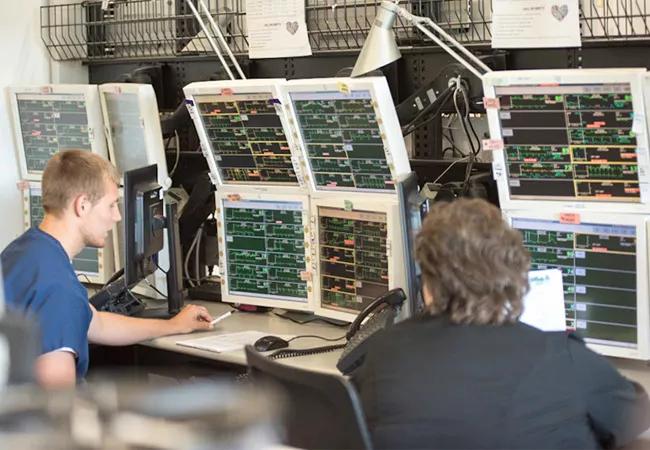
Image content: This image is available to view online.
View image online (https://assets.clevelandclinic.org/transform/dcee822f-06ae-4397-857b-b216185c97c8/16-HRT-1345-JAMA-650x450_jpg)
CMU
Hospitals have long struggled with “alarm fatigue,” when busy staff become desensitized to the constant noise emanating from cardiac telemetry monitoring systems. While less than 10 percent of the alerts are immediately clinically relevant, important warning signs can be missed in the din of nuisance pings: According to the American Heart Association (AHA), fewer than 1 in 4 adults survived an in-hospital cardiac arrest in 2013, and prior studies found that up to 44 percent of inpatient cardiac arrests are not detected appropriately.
Advertisement
Cleveland Clinic is a non-profit academic medical center. Advertising on our site helps support our mission. We do not endorse non-Cleveland Clinic products or services. Policy
“Alarm fatigue is a national phenomenon that has led to patient deaths,” says Cleveland Clinic electrophysiologist Daniel J. Cantillon, MD. “It’s not just a nuisance — it’s a threat.”
In response, The Joint Commission in 2014 required hospital systems to develop effective alarm management policies by 2016. Meanwhile professional organizations identified rampant overuse of telemetry in low-risk patients as a chief contributor to alarm fatigue.
At Cleveland Clinic, Dr. Cantillon and colleagues created a dedicated off-site central monitoring unit (CMU) that provides 24/7 cardiac telemetry monitoring for non-critically ill patients at the health system’s main campus and three of its regional hospitals. They also developed standardized criteria for putting patients on telemetry to avoid unnecessarily monitoring those at low risk.
Now results from the CMU’s first 13 months of operation have been published in the Aug. 2 issue of JAMA — and they show there’s real hope of reducing rates of nonimportant alarms without an increase in cardiopulmonary arrest events.
Designed as a sort of off-site mission-control center, Cleveland Clinic’s CMU is staffed by trained technicians with diverse backgrounds, including some with paramedic/EMT experience. Beyond providing continuous cardiac rhythm monitoring, CMU staff monitor blood pressure, heart and respiratory rates, pulse oximetry and even measures like intracranial pressure for patients in neurologic stepdown units.
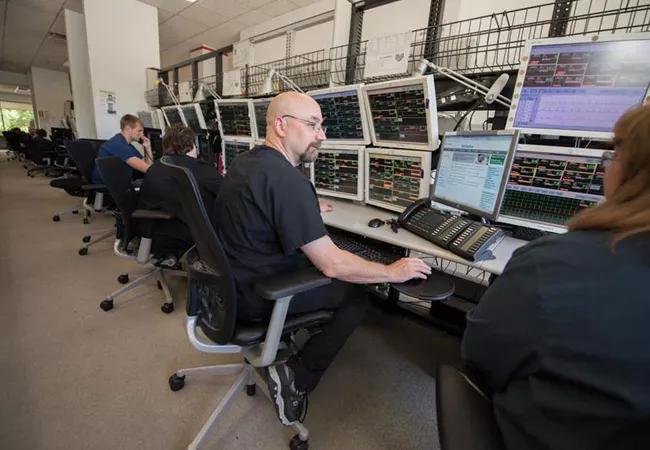
Image content: This image is available to view online.
View image online (https://assets.clevelandclinic.org/transform/7dd3efd7-0cf4-4af8-ae7e-7f13c8403e7d/16-HRT-1345-JAMA-inset_jpg)
A glimpse inside the central monitoring unit.
Advertisement
Removed from the distractions of normal hospital activities, CMU technicians provide urgent notification to bedside nurses or hospital emergency rapid response teams to aid patients in immediate danger of cardiac arrest. Such response teams — consisting, at minimum, of a physician, nurse and respiratory therapist — aren’t new, but the linkage to central monitoring is, notes Dr. Cantillon, who serves as Medical Director of the CMU.
Key to the program is a requirement that Cleveland Clinic physicians specify the reason for putting a patient on telemetry, using standardized criteria Dr. Cantillon and colleagues developed based on 2004 AHA/American College of Cardiology guidelines. In addition to common indications like atrial or ventricular tachycardia, bradycardia or post-cardiac surgery status, the team added a few not in the 2004 guidelines, including deep vein thrombosis/pulmonary embolism, stroke/transient ischemic attack and hospital transfer within 72 hours.
The first 13 months of the CMU’s operation (March 2014 to April 2015) served as the intervention period in the new JAMA study. During that time, the CMU monitored 99,048 patients and provided 410,534 notifications to 61 nursing units. The emergency response team was activated for 3,243 patients, of whom 979 (30 percent) had rhythm/rate changes occurring one hour or less before an event.
In all, the CMU detected serious problems and accurately notified on-site staff for 772 (79 percent) of those events. Advance warning was provided directly to an emergency response team for 105 patients, of whom 27 (26 percent) went on to develop cardiopulmonary arrest; 25 of those patients (93 percent) were successfully resuscitated.
Advertisement
“We showed there’s about a 1 in 4 chance that a patient our technicians are calling about will have a cardiac arrest,” says Dr. Cantillon. “That’s how good they are at spotting trouble. And if a patient arrests, there’s a 93 percent chance we’ll get them back. That’s an extraordinary number, as it compares with a national benchmark of about 24 percent survival of in-hospital cardiac arrest as reported in the AHA’s Heart Disease and Stroke Statistics – 2013 Update.”
Compared with the 13 months prior to the study (which served as the control period), the telemetry standardization resulted in a 15.5 percent reduction in the number of low-risk non-critically ill patients monitored per week, with fewer cardiopulmonary arrests overall (122 in the post-intervention period versus 126 in pre-intervention period).
“By eliminating low-risk patients from the monitor, we were able to better concentrate our efforts on the patients who really require our attention,” Dr. Cantillon explains. “That’s getting at the crux of alarm fatigue — reducing the signal-to-noise ratio.”
Since the study’s completion, the rate of accurate detection and notification of an impending arrest has risen further — from 79 percent to 84 percent. The team also continues to boost efficiency via a new telemetry module, currently completing feasibility studies, that allows the CMU to monitor more patients with fewer technicians. “Both the clinical appropriateness of care and the economics of this are moving in the right direction,” Dr. Cantillon says. “We’re getting better at what we do.”
Advertisement
He notes that while some other U.S. health systems have remote monitoring units, such units are typically located on-site and monitor a single hospital. In contrast, Cleveland Clinic’s CMU will soon expand its scope beyond the four hospitals in this study to all its affiliated hospitals, including one in Florida.
“I’m aware of no other health system doing CMU telemetry on this scale,” Dr. Cantillon says. “We hope Cleveland Clinic helps show the way forward for other systems.”
Advertisement
Advertisement

A sampling of outcome and volume data from our Heart & Vascular Institute
Concomitant AF ablation and LAA occlusion strongly endorsed during elective heart surgery

Large retrospective study supports its addition to BAV repair toolbox at expert centers
Young age, solid tumor, high uptake on PET and KRAS mutation signal risk, suggest need for lobectomy
Surprise findings argue for caution about testosterone use in men at risk for fracture
Residual AR related to severe preoperative AR increases risk of progression, need for reoperation

Findings support emphasis on markers of frailty related to, but not dependent on, age
Provides option for patients previously deemed anatomically unsuitable
 Search