Locations:





New technology can help avoid a choice between cancer and heart disease
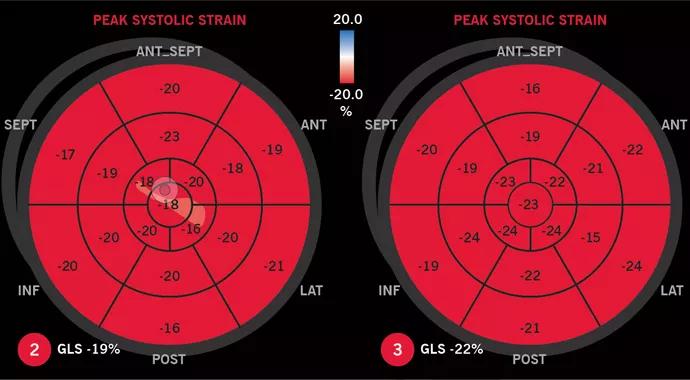
Image content: This image is available to view online.
View image online (https://assets.clevelandclinic.org/transform/1536c603-5673-435c-8da2-c458ab58ef36/Strain-Ecco-690_jpg)
Strain-Ecco-690
Advertisement
Cleveland Clinic is a non-profit academic medical center. Advertising on our site helps support our mission. We do not endorse non-Cleveland Clinic products or services. Policy
A 47-year-old woman diagnosed with invasive ductal carcinoma of the breast (estrogen receptor-negative, progesterone receptor-positive, HER-2/neu-protein-positive) was started on treatment with docetaxel, carboplatin and trastuzumab in preparation for mastectomy.
Prior to chemotherapy initiation, baseline strain echocardiography was performed at Cleveland Clinic’s Cardio-Oncology Center, which revealed a left ventricular ejection fraction (LVEF) of 65 percent with global longitudinal strain of –25.5 percent (Figure 1).
Her follow-up echocardiogram three months after the start of trastuzumab-based chemotherapy showed a LVEF of 58 percent with global longitudinal strain of –19 percent, representing a 25 percent reduction in strain from baseline (Figure 2).
The patient presented with vital signs of BP 105/69, HR 85 and RR 12. She appeared thin but in no acute distress. Her lungs were normal and her heart was in regular rhythm. S1 and S2 were normal. No gallops or murmurs were appreciated. The abdomen was soft and non-tender. Extremities were normal.
The patient was started on carvedilol at a dosage of 3.125 mg orally twice daily. Three months after carvedilol initiation, her global longitudinal strain improved to –22 percent (Figure 3). Her LVEF remained at 58 percent.
Trastuzumab is a humanized monoclonal antibody that has revolutionized the treatment of HER-2-positive breast cancer, yielding a 34 percent improvement in overall survival rate.
However, a recent Cochrane meta-analysis of randomized clinical trials demonstrated a fivefold increased risk of congestive heart failure in women receiving trastuzumab-based regimens.
Advertisement
Strain echocardiography is a new technology that allows detection of small changes in ventricular function. A relative drop of >10 percent in global longitudinal strain can help identify those patients who will have a drop in their ejection fraction three months later (sensitivity, 78 percent; specificity, 79 percent; negative predictive value, 93 percent).
Identifying subclinical left ventricular dysfunction in trastuzumab recipients offers the potential to intervene early with cardioprotective therapies with the intent to prevent a decline in left ventricular function and subsequent progression to systolic heart failure. This allows patients to remain on lifesaving chemotherapy — and avoid a choice between cancer and heart disease.
Advertisement
Advertisement
A sampling of outcome and volume data from our Heart & Vascular Institute
Concomitant AF ablation and LAA occlusion strongly endorsed during elective heart surgery
Large retrospective study supports its addition to BAV repair toolbox at expert centers
Young age, solid tumor, high uptake on PET and KRAS mutation signal risk, suggest need for lobectomy
Surprise findings argue for caution about testosterone use in men at risk for fracture
Residual AR related to severe preoperative AR increases risk of progression, need for reoperation

Findings support emphasis on markers of frailty related to, but not dependent on, age
Provides option for patients previously deemed anatomically unsuitable
 Search