Locations:





How the HVI Affiliate Program helped an academic center revamp its approach to early extubation
Image content: This image is available to view online.
View image online (https://assets.clevelandclinic.org/transform/f9154eb3-f702-4f44-a176-169001428dc1/17-HRT-4799-Froedtert-Affiliate-CQD_jpg)
Case Study in Collaboration: Decreasing Prolonged Post-CABG Ventilation Rates
When Froedtert & the Medical College of Wisconsin Froedtert Hospital entered into an affiliation relationship with Cleveland Clinic’s Miller Family Heart & Vascular Institute in early 2016, a comprehensive assessment of the Milwaukee-based academic medical center’s cardiovascular services was a key part of the process. That assessment revealed that one aspect of Froedtert Hospital’s cardiac surgery service was not up to its broader standards — specifically, the rate of prolonged mechanical ventilation in patients following coronary artery bypass graft surgery (CABG).
Advertisement
Cleveland Clinic is a non-profit academic medical center. Advertising on our site helps support our mission. We do not endorse non-Cleveland Clinic products or services. Policy
The extent of the opportunity for improvement was clear from Froedtert Hospital’s incidence of prolonged ventilation time (i.e., > 24 hours) following CABG for the first three quarters of 2016: 9.7 percent. This was higher than the Cleveland Clinic rate (6.5 percent) and the benchmark of 7.9 percent from the Society of Thoracic Surgeons (STS) national database.
The Froedtert & Medical College of Wisconsin (MCW) cardiovascular leadership saw the issue as a priority since early extubation after cardiac surgery reduces length of stay in both the ICU and the hospital and lowers patients’ risk of developing pneumonia and other infectious complications. In response, they set out to improve the prolonged postoperative mechanical ventilation metric in their 20-bed adult cardiovascular ICU (CVICU) by following a plan-do-study-act model with assistance from Cleveland Clinic.
Early in the process, a Cleveland Clinic cardiothoracic anesthesiologist and a clinical consultant from Cleveland Clinic’s Heart & Vascular Institute Affiliate Program analyzed Froedtert Hospital’s postoperative ventilation data with the hospital’s postoperative care team, underscoring the importance of this metric to the hospital’s overall STS rating for CABG procedures. Key members of the Froedtert & MCW cardiovascular team made a site visit to learn from processes in place at Cleveland Clinic. Monthly conference calls were also held between the Froedtert & MCW cardiovascular team and Cleveland Clinic consultants before and after the site visit.
Advertisement
These efforts led to the formation of a CVICU interprofessional team at Froedtert Hospital to guide and champion efforts to change practice in support of early extubation following CABG. The team included nurse leaders, CVICU staff RN Quality Council co-chairs, critical care anesthesiology providers, respiratory therapists, a physical therapist and a pharmacist.
The interprofessional team drew on Cleveland Clinic recommendations and a literature review to develop a post-cardiac surgery early extubation protocol providing guidance to all caregivers for management during the preoperative, intraoperative, handoff (OR to CVICU) and postoperative phases of care. The protocol was designed to facilitate early identification of patients eligible for early extubation and to empower nurses and respiratory therapists to drive the early extubation process in appropriate cases.
Among the protocol’s notable aspects:
Following implementation of the protocol in the fourth quarter of 2016, Froedtert Hospital’s rate of CABG patients with prolonged ventilation times plummeted in the subsequent two quarters — to 3.7 percent in the first quarter of 2017 (based on a sample of 27 CABG patients) and to 0 percent in the second quarter of 2017 (sample of 30 CABG patients) (see Figure).
Advertisement
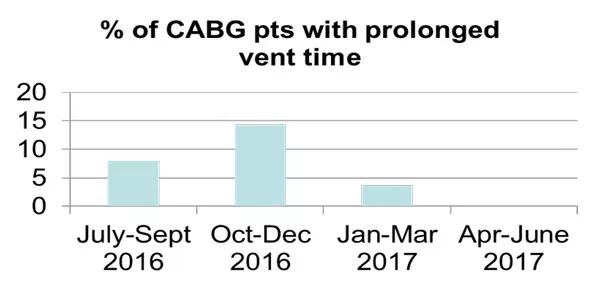
Image content: This image is available to view online.
View image online (https://assets.clevelandclinic.org/transform/04b60510-4969-4cce-bc82-30d52e3e69a2/17-HRT-4799-Froedtert-Affiliate-CQD-inset_jpg)
Figure. Bar graph showing the percentage of CABG patients with prolonged postoperative ventilation times at Froedtert Hospital over time. Prolonged ventilation requirements plummeted after implementation of an early extubation protocol in the fourth quarter of 2016.
“The success we have seen in driving down post-CABG prolonged ventilation could not have been achieved without the efforts of a multidisciplinary team,” says Froedtert & MCW cardiothoracic surgeon Paul Pearson, MD, PhD. “This team, including cardiovascular staff and providers, inpatient nursing, anesthesiologists and respiratory therapists, collaborated to achieve marked improvement in this critical patient safety measure. This achievement is a testament to our focus on improving quality using external benchmarks, and it further illustrates the value our partnership with Cleveland Clinic brings to patients in southeastern Wisconsin.”
“Success like this underscores the importance of data review, clinical protocols and collaboration, which is the foundation of our affiliate program,” adds Jeffrey Rich, MD, Chair of Strategic Operations for Cleveland Clinic’s Heart & Vascular Institute Affiliate Program. “We congratulate the Froedtert team on a phenomenal effort to reduce the incidence of prolonged ventilation.”
For more on affiliation and alliance opportunities with Cleveland Clinic’s Heart & Vascular Institute, visit ahsproviders.com.
Advertisement
Advertisement

A sampling of outcome and volume data from our Heart & Vascular Institute
Concomitant AF ablation and LAA occlusion strongly endorsed during elective heart surgery
Large retrospective study supports its addition to BAV repair toolbox at expert centers
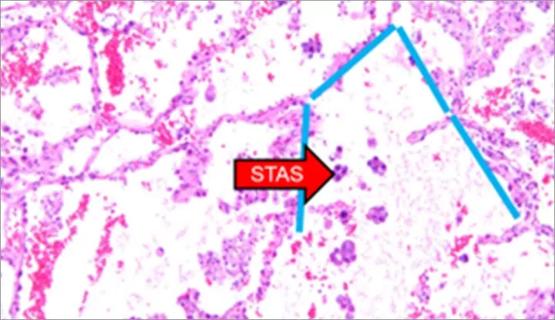
Young age, solid tumor, high uptake on PET and KRAS mutation signal risk, suggest need for lobectomy
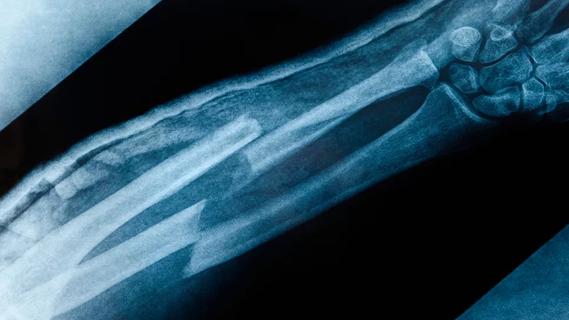
Surprise findings argue for caution about testosterone use in men at risk for fracture
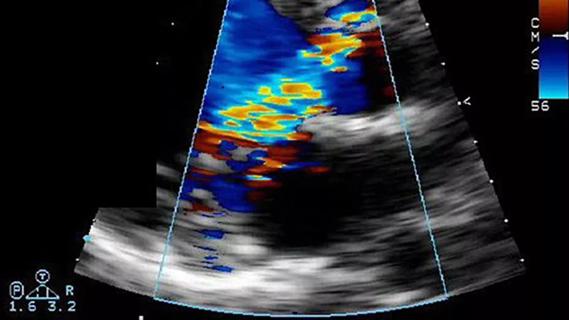
Residual AR related to severe preoperative AR increases risk of progression, need for reoperation
Findings support emphasis on markers of frailty related to, but not dependent on, age
Provides option for patients previously deemed anatomically unsuitable
 Search