Locations:





 Search
Approach useful for challenging colonic lesions
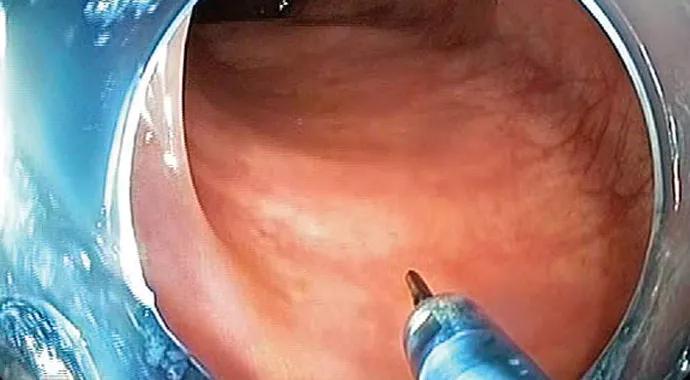
Image content: This image is available to view online.
View image online (https://assets.clevelandclinic.org/transform/f359f7ac-82a7-4923-8603-99933b12ba30/ESD-Image-1-690_jpg)
ESD-Image-1-690
A 60-year-old man with a medical history of atrial fibrillation, hypertension and COPD presented with rectal bleeding. A colonoscopy was performed at an outside hospital, which revealed a large colonic lesion. The patient was referred to the Digestive Disease Institute for Emre Gorgun, MD, to perform a segmental bowel resection.
Advertisement
Cleveland Clinic is a non-profit academic medical center. Advertising on our site helps support our mission. We do not endorse non-Cleveland Clinic products or services. Policy
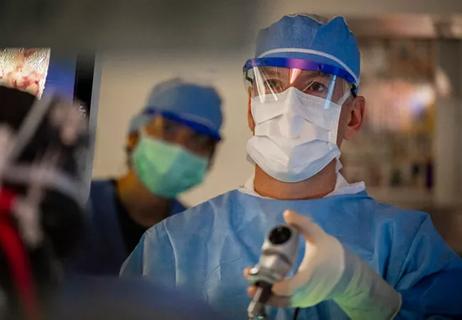
After an extensive workup, the patient was found to have a lesion that was confined to the colon. Therefore, it was decided to treat this high-surgical risk patient using an intraluminal surgical approach. He underwent en bloc endoscopic submucosal dissection (ESD) of this large colonic lesion in the cecum. The lesion was 3 cm away from the ileocecal valve and involved 35 percent of the circumference of the lumen. Using special endoluminal instruments including a dual knife and hook knife, the lesion was marked circumferentially with a 3 mm clear margin. This step was followed by submucosal injection and lifting using a concentrated hypromellose/indigo carmine solution.
Once the mucosa had been scored and lifted, submucosal attachments beneath the lesion were divided with the fine endoscopic tools. The dissection was facilitated using a distal disposable cap that was attached at the end of the colonoscope. En bloc removal of the lesion was successfully achieved, and the specimen measured 3.2 cm in diameter. The patient was discharged on postoperative day 1 with no complications. The final pathology revealed tubulovillous adenoma with clear deep and circumferential margins.
In the United States, the ESD method is presently used only in a small number of centers to remove large colonic polyps. Currently, with few exceptions, patients with large sessile benign colonic polyps are referred by gastroenterologists to surgeons for segmental colorectal resections. The ESD technique to keep polyps and large intraluminal lesions intact during removal may enable precise pathological assessment of the resected lesions. ESD is a safe and useful technique in carefully selected patients. We expect that it will soon become more widely used by surgeons and endoscopists for large colonic lesions.
Advertisement
Dr. Gorgun is a minimally invasive-robotic and laparoendoscopic surgeon and the quality officer in the Digestive Disease Institute’s Department of Colorectal Surgery. He specializes in colorectal surgery, with a particular interest in malignant diseases of the rectum and colon.
Advertisement
Advertisement

Strong patient communication can help clinicians choose the best treatment option
ctDNA should be incorporated into care to help stratify risk pre-operatively and for post-operative surveillance

The importance of raising awareness and taking steps to mitigate these occurrences
New research indicates feasibility and helps identify which patients could benefit

Treating a patient after a complicated hernia repair led to surgical complications and chronic pain
Standardized and collaborative care improves liver transplantations
Fewer incisions and more control for surgeons

Caregiver collaboration and patient education remain critical