Locations:





High-grade müllerian carcinoma in a 75-year-old female
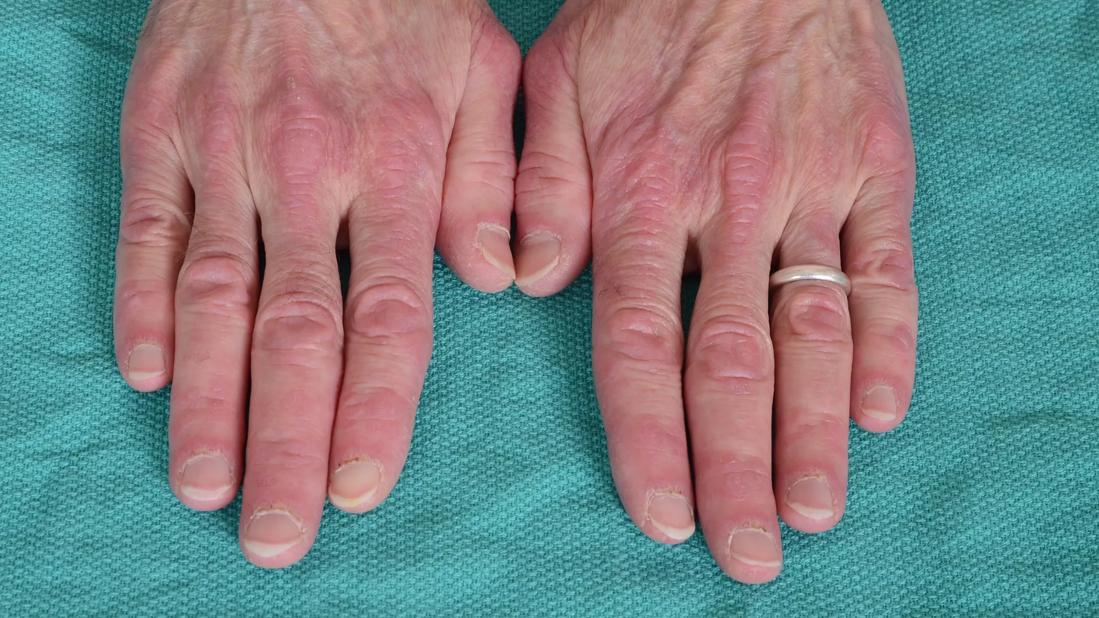
Image content: This image is available to view online.
View image online (https://assets.clevelandclinic.org/transform/28639e7d-370f-4f23-bf27-edf38edcdb06/Gottrons-papules_jpg)
Gottrons papules
A 75-year-old female originally diagnosed with dermatomyositis, an idiopathic inflammatory myositis affecting the skin and muscles, in October 2020. She was treated with five days of pulse steroids and high doses of steroids tapered over the next several months, with improvement in her symptoms. Once steroids were tapered, her weakness worsened. She was presumed to have steroid-induced myopathy, and she was started on low-dose mycophenolate. However, her weakness and dysphagia continued to progress.
Advertisement
Cleveland Clinic is a non-profit academic medical center. Advertising on our site helps support our mission. We do not endorse non-Cleveland Clinic products or services. Policy
She again presented in August 2021 with severe proximal weakness, a 15-lb. weight loss and dysphagia requiring a nasogastric tube placement. Creatine kinase and erythrocyte sedimentation rate were normal, and her C-reactive protein was slightly elevated. Electromyography (EMG) was suggestive of an inflammatory myopathy.
Computed tomography (CT) of the chest, abdomen and pelvis indicated retroperitoneal lymphadenopathy, pulmonary ground-glass opacities and findings suggestive of pulmonary arterial hypertension. Positron emission tomography (PET) confirmed F-fluorodeoxyglucose (FDG) avid abdominal and supraclavicular lymphadenopathy. Endometrial biopsy was negative.
Retroperitoneal lymph node biopsy revealed a high-grade müllerian carcinoma. Cleveland Clinic Cancer Center specialists consulted with the patient regarding treatment options, but she decided to pursue hospice care. The patient died two days later.
Watch as Juliette Yedimenko, MD, staff in the Department of Rheumatologic and Immunologic Diseases in the Orthopaedic and Rheumatologic Institute, discusses the case and the importance of malignancy screening in dermatomyositis.
Video content: This video is available to watch online.
View video online (https://www.youtube.com/embed/sFg9DJwLFIo?feature=oembed)
An Unfortunate Case of Dermatomyositis
“This case highlights the importance of malignancy screening in dermatomyositis,” says Dr. Yedimenko. “Dermatomyositis is associated with a six-fold higher risk of malignancy compared with the general population, especially within the first two years after diagnosis. Rheumatologists must remain vigilant in evaluating these patients for malignancy, especially in cases of refractory disease and unusual clinical presentations.” Research demonstrates that malignancy screening is most beneficial in patients with dermatomyositis within 12 months of diagnosis who have classic dermatomyositis, are over 50 years old and present with dysphagia.
Advertisement
Advertisement

Treatment strategies require understanding of pathomechanisms
Education, prevention strategies and monitoring serves this at-risk group
Treatment for scleroderma can sometimes cause esophageal symptoms

Lupus Clinic providers collaborate to advance treatment and understanding

Older Psoriasis Patients May Experience Quicker Transition

Cleveland Clinic’s Rheumatic Lung Disease program treats patients with complex conditions

Symptoms complement one another

E-coaching program is tailored for those with the disease
 Search