Locations:





Large surgeries can be done in patients refusing transfusion
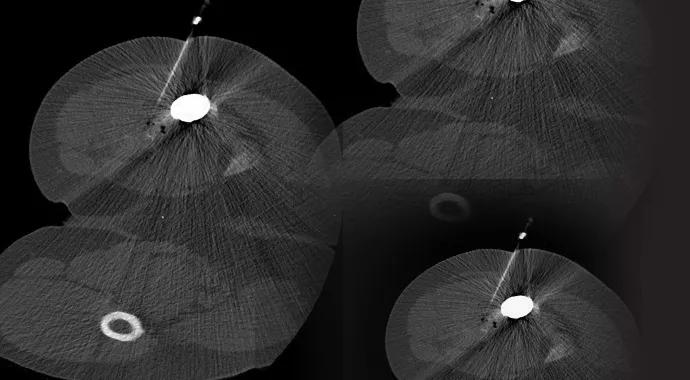
Image content: This image is available to view online.
View image online (https://assets.clevelandclinic.org/transform/72d2b840-0342-4a86-915f-4a640baec246/15-ORT-979-Leitman-Hero-Image-690x380pxl_jpg)
15-ORT-979-Leitman-Hero-Image-690x380pxl
By Steven A. Lietman, MD, and Carlos Higuera, MD
Advertisement
Cleveland Clinic is a non-profit academic medical center. Advertising on our site helps support our mission. We do not endorse non-Cleveland Clinic products or services. Policy
A 49-year-old man presented with femoral pain one year after undergoing resection of a proximal femoral osteosarcoma with a negative margin and ipsilateral proximal femoral replacement. The resection was followed by chemotherapy, and he initially fared well until he developed femoral pain that dramatically worsened prior to his current presentation. Radiographs and CT scans suggested recurrence of the osteosarcoma, which was confirmed by needle biopsy (Figure). Chest CT did not reveal metastasis.
Because the proximal femoral implant extended into the hip joint, an external hemipelvectomy was required to achieve an adequate negative margin. Hemipelvectomy was recommended to the patient, and after lengthy discussion of its benefits, risks and alternatives, he agreed to proceed with the procedure.
Notably, the patient would not accept blood for religious reasons (he was a Jehovah’s Witness). A hematology consult was obtained, but the hematology team was unwilling to give erythropoietin based on the patient’s preoperative hematocrit of 45.8 percent. So the decision was made to intraoperatively administer the antifibrinolytic agent tranexamic acid instead.
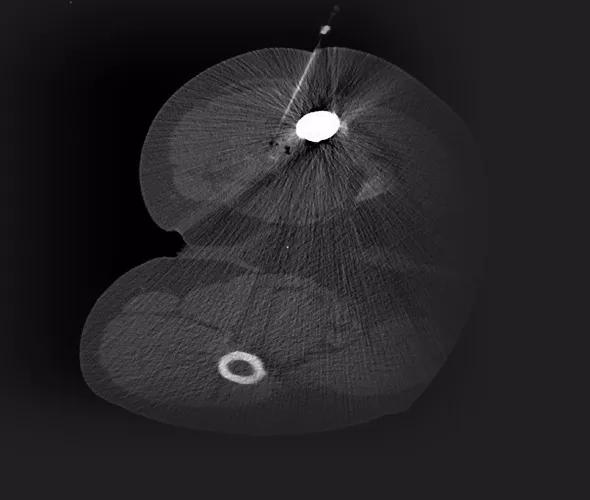
Image content: This image is available to view online.
View image online (https://assets.clevelandclinic.org/transform/80367298-c0e1-49f5-a1c3-956c4a83c1b8/15-ORT-979-Leitman-Inset-Image-590pxl-width-02_jpg)
Figure. CT showing the biopsy needle entering the ectopic recurrent osteosarcoma. Because the proximal femoral implant extended into the hip joint, a hemipelvectomy was required to achieve an adequate margin.
Tranexamic acid was administered intravenously at a dose of 1 gram at incision and then as a drip at 10 μg/kg/hr throughout the course of the surgery. The external hemipelvectomy was performed with a negative margin and a blood loss of approximately 450 mL. A cell saver was used and returned 150 mL of blood to the patient. Body temperature was maintained at 36 to 37°C. The wound was closed but developed drainage, and a negative pressure dressing was placed. Several negative pressure dressing changes followed, and the wound was closed without further complication.
Advertisement
The patient’s lowest hematocrit was 26.6 percent. During the period of negative pressure dressing changes, erythropoietin was given and his hematocrit improved. The patient fared well postoperatively, and his sutures were removed six weeks after surgery.
Hemipelvectomy is an enormous operation that ordinarily involves major blood loss and multiple transfusions. This case, which has been submitted for publication, is the first to our knowledge in which tranexamic acid was used to decrease bleeding and avoid transfusion in a hemipelvectomy because of the patient’s refusal to accept blood.
It is the second known report of a hemipelvectomy in a Jehovah’s Witness patient who would not accept blood. In the first report, erythropoietin support was used rather than tranexamic acid. In the case reported here, our hematology colleagues advised that the risks of preoperative erythropoietin use would outweigh the benefits, in view of the patient’s preoperative hematocrit of 45.8 percent.
Additionally, one of the authors (S.A.L.) has resected a telangiectatic osteosarcoma of the distal femur and reconstructed it with a distal femoral replacement in a Jehovah’s Witness patient, but this latter surgery was done under tourniquet. All these cases collectively illustrate that large surgeries can be done in patients who refuse transfusion for religious reasons, provided that careful preoperative planning takes place.
It is unclear whether the tranexamic acid had an effect on bleeding during surgery in the case reported here. This synthetic amino acid has sometimes been associated with risk of seizures, although there were no such complications in this case. While further prospective examination of tranexamic acid in major ablative surgery is warranted, confidence in its general safety is bolstered by its growing use to reduce the need for blood transfusions in joint arthroplasty, as detailed in this Consult QD post.
Advertisement
The resourceful approach to blood management in this case is characteristic of Cleveland Clinic’s Musculoskeletal Tumor Center, where a team of orthopaedic oncologists collaborates with expert colleagues from across Cleveland Clinic, including hematologists, radiation and medical oncologists, pathology subspecialists, and non-tumor colleagues in the Department of Orthopaedic Surgery. It is precisely for this type of challenging case — where a fresh, creative approach to clinical problem-solving is required — that we bring this collaborative, interdisciplinary ethic to our caregiving.
Dr. Lietman is Co-Director of the Musculoskeletal Tumor Center in the Department of Orthopaedic Surgery.
Dr. Higuera is a surgeon in the Center for Adult Reconstruction in the Department of Orthopaedic Surgery.
Advertisement
Advertisement
Biologic approaches, growing implants and more

Study reports zero infections in nearly 300 patients
How to diagnose and treat crystalline arthropathy after knee replacement
Study finds that fracture and infection are rare

Center will coordinate, interpret and archive imaging data for all multicenter trials conducted by the foundation’s Osteoarthritis Clinical Trial Network

Reduced narcotic use is the latest on the list of robotic surgery advantages

Cleveland Clinic specialists offer annual refresher on upper extremity fundamentals
Cleveland Clinic orthopaedic surgeons share their best tips, most challenging cases and biggest misperceptions
 Search