Locations:





Cleveland Indians Head Team Physician talks sports medicine
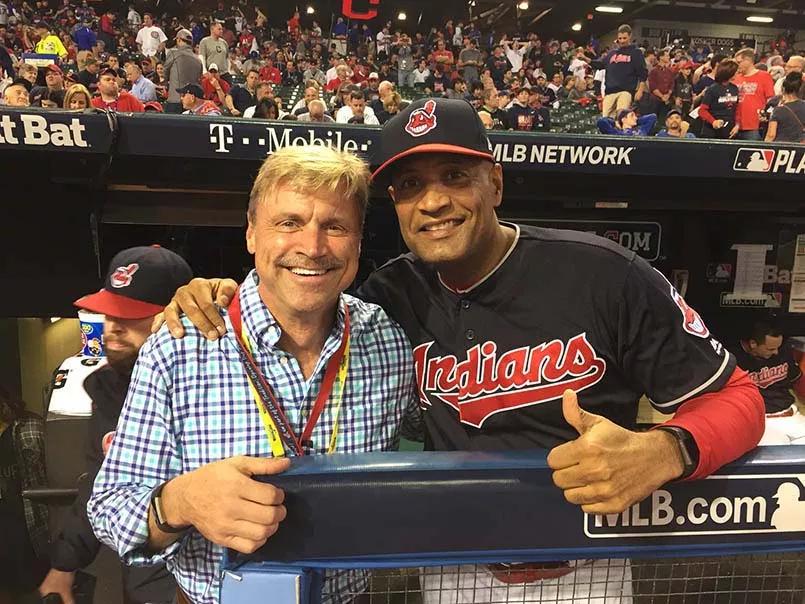
Image content: This image is available to view online.
View image online (https://assets.clevelandclinic.org/transform/e2ebecb0-7c6a-45b1-aa08-d787f905d346/IMG_3718_CQD_Hero_805_jpg)
IMG_3718_CQD_Hero_805
Mark Schickendantz, MD, is in his 26th season as Head Team Physician for the 2016 American League champions, the Cleveland Guardians. He is also Director of the Center for Sports Health at Cleveland Clinic. Here, Dr. Schickendantz discusses changes in care, what’s different about elite athletes, the quiet room, what makes being a team physician great, and more.
Advertisement
Cleveland Clinic is a non-profit academic medical center. Advertising on our site helps support our mission. We do not endorse non-Cleveland Clinic products or services. Policy
DESCRIBE YOUR CLEVELAND GUARDIANS MEDICAL TEAM.
The Head Athletic Trainer used to oversee everything. Now the Senior Medical Director, a relatively new position in baseball, manages the administrative side of medical care. He and I work side-by-side to organize care for the players. We have athletic trainers, physical therapists, a strength conditioning coach and nutritionists. We also have a wonderful compliment of alternative or non-traditional medical providers. We have had an acupuncturist for several years now and we offer chiropractic care and massage therapy.
On the physician side, we have a large group, including four surgeons, a medical provider and a primary care sports medicine physician. The beauty of working at Cleveland Clinic is having access to some of the best subspecialists in the world for anything you can imagine. We’ve got an extensive list of consultants who we work with regularly.
WHAT’S CHANGED OVER THE YEARS?
Our diagnostic capabilities have improved, and our understanding of the throwing athlete, in particular pitchers, has evolved. I think we’re better at what we do, and over the past five years, we have begun to operate less than we used to. But the most important change is our understanding that certain things in these athletes’ anatomy, in particular their shoulder and elbow, are necessary for them to do what they do, and if we over-correct them, it can be problematic. We’ve actually become more conservative.
If you look at an MRI of the shoulder of a professional baseball player, there are all sorts of things that are going to scare you to death. But they don’t bother him. In fact, they’re necessary for him to do what he does. If you change that, correct it, you’ve ruined him.
Advertisement
They’re wired differently and it’s remarkable to watch. It really is.
TELL US MORE ABOUT PREVENTIVE CARE IN THE PROS.
We take a holistic approach. We don’t just manage orthopaedic or medical needs, but players’ nutritional and psychological needs as well. During spring training, athletes have a lecture from a sleep expert. At Progressive Field (home of the Indians), we have a quiet room with comfortable chairs where the guys can take a nap. It’s amazing to walk into our athletic training room and see five guys with acupuncture needles in them.
We also offer nutrition services and cooking classes for significant others. If there are certain dietary restrictions, we understand that.
Physical examinations during spring training are amazingly complete. We do a very sophisticated visual analysis, a dental screening, anything you can possible imagine, we offer our guys. They get good total healthcare, not just injury care, and it’s very much a whole-body approach.
WHY DO YOU LOVE BEING A TEAM PHYSICIAN
It’s a very different style of practice, and yes, it is exciting. You’re certainly much more under the microscope when you’re dealing with pro athletes. When agents and coaches and others get involved, you just have to stick to the medicine and always do what’s right for your athlete, regardless of the background noise. Never ever bow to pressure from an outside source that is to the detriment of the health of the athlete. Ever. Even if it costs you your job. You have to be willing to do that.
Advertisement
Read more from Cleveland Clinic Sports Health about arm injuries and a variety of other topics. Learn more about Cleveland Clinic Sports Health Sideline Guideline app for iPhone or iPad.
Featured Image: Dr. Schickendantz with Indians First Base Coach Sandy Alomar Jr.
Advertisement
Advertisement
Biologic approaches, growing implants and more
Study reports zero infections in nearly 300 patients
How to diagnose and treat crystalline arthropathy after knee replacement
Study finds that fracture and infection are rare
Center will coordinate, interpret and archive imaging data for all multicenter trials conducted by the foundation’s Osteoarthritis Clinical Trial Network

Reduced narcotic use is the latest on the list of robotic surgery advantages
Cleveland Clinic specialists offer annual refresher on upper extremity fundamentals
Cleveland Clinic orthopaedic surgeons share their best tips, most challenging cases and biggest misperceptions
 Search