Locations:





 Search
Increases costs without adding benefit in healthy adults
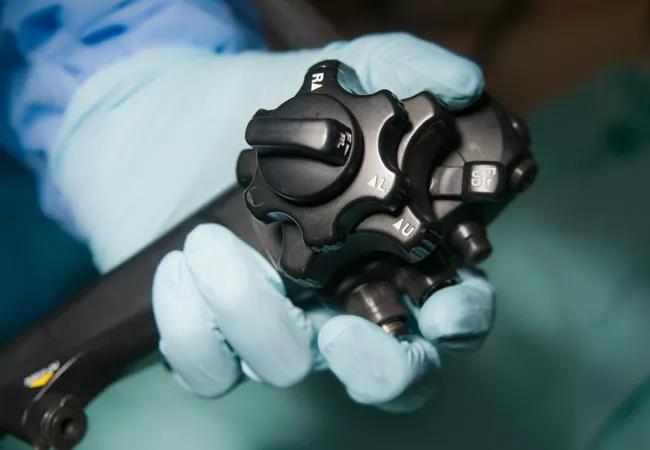
Image content: This image is available to view online.
View image online (https://assets.clevelandclinic.org/transform/06460dcc-6b9b-4a00-a781-279c52161e1a/16-DDI-309-Capnography-CQD-650x450_jpg)
16-DDI-309-Capnography-CQD-650×450
Capnographic monitoring fails to improve the detection of hypoxemia in healthy subjects undergoing esophagogastroduodenoscopy (EGD) or colonoscopy with moderate sedation, say researchers from Cleveland Clinic’s Digestive Disease & Surgery Institute (DDSI).
Advertisement
Cleveland Clinic is a non-profit academic medical center. Advertising on our site helps support our mission. We do not endorse non-Cleveland Clinic products or services. Policy
This finding from the first randomized, controlled clinical trial conducted in ASAPS I and II patients undergoing these procedures challenges American Society of Anesthesiology recommendations that capnographic monitoring be added to standard monitoring for patients when moderate sedation is used.
“Our study provided data supporting the opposite view, that capnography in these patients did not change the incidence of hypoxemia in routine colonoscopy or upper endoscopy,” says principal author and DDI Gastroenterology and Hepatology Department Chairman John Vargo, MD, MPH. “We found capnography provided no additional safety benefit for these patients.”
The DDI group has been studying sedation practices in gastroenterology for two decades. In 2014, they published another first-of-its kind study that found no difference in rates of hypoxia with open or blinded capnography in ambulatory colonoscopy with moderate sedation. Armed with this evidence, they challenged proposed regulatory changes based on expert opinion.
Similarly, the ASA’s recommendation for capnography as an adjunct to standard monitoring for routine EGD and colonoscopy was not based on evidence. Rather, it was likely made in the absence of hard data.
“We do not have any concerns or criticisms about the recommendation. The ASA erred on the side of caution in the name of patient safety,” says Dr. Vargo. “It is up to practitioners to provide the data necessary to either support or refute the recommendation with solid science.”
Advertisement
Dr. Vargo does not question the ASA’s recommendation to use capnography in deep sedation, or in patients with significant comorbidities, when aberrations in respiration can occur before oxygen levels diminish.
“Our own studies support that it lowers the rate of hypoxemia in colonoscopy with propofol sedation,” he says. “In our work 10 to 15 years ago, we found it difficult to assess respiration visually in a darkened room, and in this regard, capnography can be of tremendous benefit.”
Cleveland Clinic follows other evidence-based sedation guidelines for GI endoscopic procedures. Such guidelines are revised as the amount, quality and levels of evidence accrue.
“We now have a randomized, controlled study that provides important data in an area that previously had none,” says Dr. Vargo. “These data suggest that healthy patients undergoing routine EGD or colonoscopy will not benefit from capnography. It should be reserved for patients with adverse physiology and those targeted for deep sedation.”
Further studies on this population are planned. “We look forward to other groups validating our findings,” he says.
Advertisement
Advertisement

Strong patient communication can help clinicians choose the best treatment option
ctDNA should be incorporated into care to help stratify risk pre-operatively and for post-operative surveillance

The importance of raising awareness and taking steps to mitigate these occurrences
New research indicates feasibility and helps identify which patients could benefit

Treating a patient after a complicated hernia repair led to surgical complications and chronic pain
Standardized and collaborative care improves liver transplantations
Fewer incisions and more control for surgeons

Caregiver collaboration and patient education remain critical