Locations:





Leveraging advanced remote monitoring technologies to personalize assessment for permanent pacemaker need
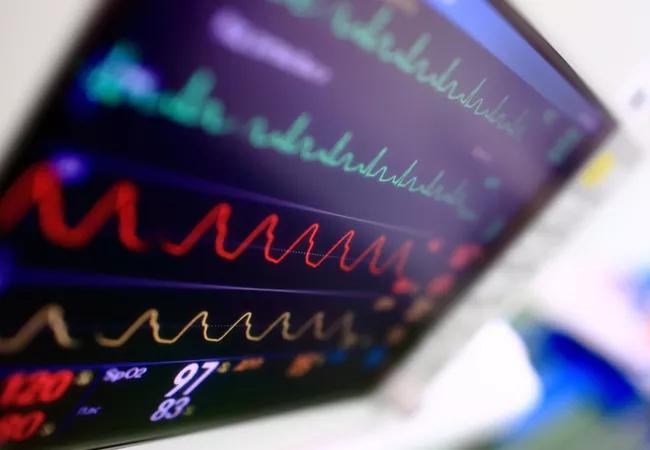
Image content: This image is available to view online.
View image online (https://assets.clevelandclinic.org/transform/5556a26a-0dd0-4862-ba90-6df927ed1585/21-HVI-2588338_ECG-monitoring_650x450_jpg)
21-HVI-2588338_ECG-monitoring_650x450
Bradyarrhythmias are not unusual at baseline and following transcatheter aortic valve replacement (TAVR), but this finding alone does not predict the need for implantation of a permanent pacemaker (PPM). So found the prospective Brady-TAVR study of nearly 100 patients who had extended continuous ECG readings before and after undergoing TAVR at Cleveland Clinic. Whether patients should have a pacemaker was determined by their caring physicians, who were blinded to the continuous ECG recording findings.
Advertisement
Cleveland Clinic is a non-profit academic medical center. Advertising on our site helps support our mission. We do not endorse non-Cleveland Clinic products or services. Policy
“Finding asymptomatic bradyarrhythmias through ambulatory monitoring doesn’t necessarily translate to the need for a pacemaker,” says Khaldoun Tarakji, MD, MPH, Associate Section Head of Cardiac Electrophysiology and Pacing at Cleveland Clinic and corresponding author of the study, which was published in Heart Rhythm. “Acquiring more data should help guide us, but sometimes can lead to unwarranted decisions.”
An important post-TAVR complication is disturbance of the heart’s conduction system, sometimes requiring implantation of a PPM. But a pacemaker is not without drawbacks, especially for younger patients, who are increasingly opting for TAVR instead of open surgery.
“Recent national registry data and large studies demonstrate a post-TAVR permanent pacemaker implantation rate of between 7% and 20%,” notes study co-author Amar Krishnaswamy, MD, Section Head of Invasive and Interventional Cardiology at Cleveland Clinic. He adds that modification to the valve deployment technique has allowed Cleveland Clinic to achieve annual PPM rates as low as 2%.
Despite such reductions at some centers in recent years, placement of a PPM after TAVR is still somewhat common, and many patients who receive one are found to not actually need one when assessed 30 days later. Whether baseline extended rhythm monitoring can predict need for a permanent pacemaker post-TAVR has not been well studied, nor has the utility of extended rhythm monitoring following TAVR.
The study included 96 patients who underwent TAVR at Cleveland Clinic from June 2017 to August 2018 (mean age, 80.3 ± 7.5 years; 72% male).
Advertisement
Patients underwent continuous ECG rhythm recording for two weeks before TAVR using an ECG patch. When admitted for TAVR, they had routine monitoring overnight on telemetry with data and ECGs recorded. At discharge, patients were monitored by patch for another two weeks, then again two to three months later for two weeks.
The patients’ caring physicians (primarily interventional cardiologists, with electrophysiologists as needed) were blinded to the results of the ECG patch in determining the need for a PPM; ECG recordings were adjudicated by an independent cardiologist, with blinding ended only if a life-threatening finding was detected by the study team based on predefined criteria for notification.
Bradyarrhythmias (defined as a pause ≥ 3 seconds) were detected by ECG patch at the following rates:
Post-TAVR, PPMs were implanted as follows:
No patient required PPM implantation after the ECG patch monitoring at two to three months of follow-up.
Baseline predictors of the need for a PPM were right bundle branch block and increased QRS duration detected on standard 12-lead ECG.
Dr. Tarakji highlights the following key takeaways from the study:
Advertisement
Dr. Tarakji believes the book is not yet closed on whether extended ECG monitoring should be used to help determine the need for a pacemaker following TAVR. As a result of this study, he feels comfortable that when there is no clinical indication, extensive ECG monitoring before TAVR or at two months after TAVR is not necessary and in fact might lead to overtreatment with PPM placement. He adds, however, that it may still have a role immediately after TAVR, especially in the early period after discharge.
“In cases that are not clear-cut, more ECG monitoring may help the clinician make the best decision and avoid rushing a decision about implanting a pacemaker,” Dr. Tarakji explains. “Permanent pacemakers should be used selectively post-TAVR. Avoiding their use when not needed should be the goal, but we have to make that decision safely. Newer ECG patch technologies that enable us to monitor patients in real time could enable us to make better decisions safely, and this needs to be studied further.”
Additionally, because this investigation was small and conducted in a single high-volume institution where 95% of patients received a balloon-expanding valve, its results may not be generalizable. “In TAVR patients who receive self-expanding valves, delayed conduction abnormalities may be seen,” observes study co-author Samir Kapadia, MD, Chair of Cardiovascular Medicine at Cleveland Clinic.
“A larger multicenter trial should be conducted to further analyze the benefit of extended rhythm monitoring and predictors of pacemaker implantation,” Dr. Krishnaswamy concludes. “Given the high level of permanent pacemaker implantation after TAVR, we need to more definitively assess when these devices are actually needed.”
Advertisement
Advertisement

A sampling of outcome and volume data from our Heart & Vascular Institute
Concomitant AF ablation and LAA occlusion strongly endorsed during elective heart surgery
Large retrospective study supports its addition to BAV repair toolbox at expert centers
Young age, solid tumor, high uptake on PET and KRAS mutation signal risk, suggest need for lobectomy
Surprise findings argue for caution about testosterone use in men at risk for fracture
Residual AR related to severe preoperative AR increases risk of progression, need for reoperation

Findings support emphasis on markers of frailty related to, but not dependent on, age
Provides option for patients previously deemed anatomically unsuitable
 Search