Locations:





Excellent response seen with ongoing use in patients as young as 11
More than three-fourths of children with intractable migraine treated with botulinum toxin type A (Botox®) injections at Cleveland Clinic Children’s have obtained relief, according to the pediatric neurologist who administers the injections.
Advertisement
Cleveland Clinic is a non-profit academic medical center. Advertising on our site helps support our mission. We do not endorse non-Cleveland Clinic products or services. Policy
“Many of these children had frequent, severe headaches for a long time and had failed two to four medications,” says Mohammed Aldosari, MD, Director of Cleveland Clinic Children’s Center for Pediatric Neurosciences. “The fact that most come back regularly for injections is a testament to the treatment’s effectiveness.”
Forty patients as young as 11 currently return every three months for injections of the neurotoxic protein, which is believed to work by blocking nerve signals. No patient has suffered significant side effects or discontinued the therapy due to side effects.
In each session, areas of high nerve density in the forehead, temples, back of head, and neck and shoulder region are injected. Afterward, patients are given the option of receiving extra injections in any area.
After a few sessions, the treatment may be individualized to bypass certain areas and concentrate on others.
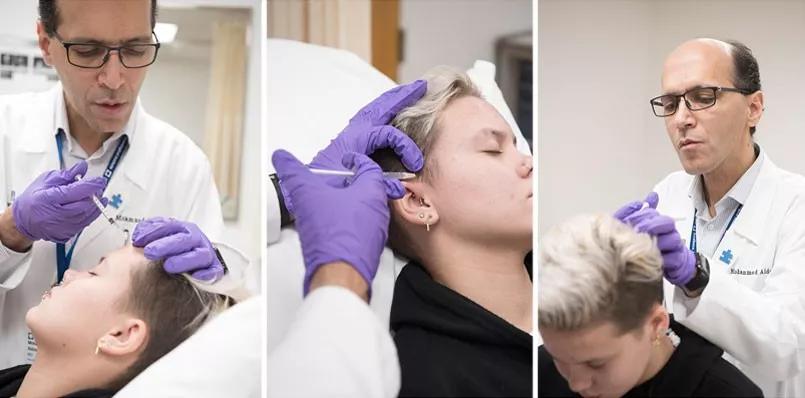
Image content: This image is available to view online.
View image online (https://assets.clevelandclinic.org/transform/472a004e-4f25-4398-a98d-9f886750663e/19-NEU-6054-inset-botox-for-pediatric-migraine_jpg)
Dr. Aldosari administering botulinum toxin injections at several possible treatment sites.
Concerned parents are usually reassured of the therapy’s safety when they learn Dr. Aldosari has 15 years’ experience using botulinum toxin injections to treat spasticity. In this setting, he delivers larger doses of the agent to patients as young as 2 years old.
For intractable migraine, three out of four young patients respond favorably to the treatment. “The injections reduce emergency department visits, school absences and medication use, and they have a huge impact on quality of life,” Dr. Aldosari notes.
Advertisement
Nonresponders are advised to pursue a different path. “They may have multiple underlying issues and require chronic pain rehabilitation or other treatments,” he says.
Although botulinum toxin is FDA-approved for the treatment of intractable migraine, the indication does not extend to patients under age 18. For this reason, many providers are reluctant to inject young patients, who end up traveling to a limited number of pediatric centers offering the therapy.
Dr. Aldosari spends the necessary time to obtain coverage for each patient. “We call the insurance company and tell them the child is debilitated and has failed multiple medications,” he says. “Nine times out of 10, coverage is approved.”
Dr. Aldosari and his colleagues plan to publish data on their experience with botulinum toxin for pediatric migraine to facilitate FDA approval and loosen insurance coverage. He hopes this will allow the injections to be made available at a younger age and expanded to use for other types of pediatric headaches.
“We have used botulinum toxin successfully for chronic daily headache and believe it might be helpful for tension headache, but these uses are not covered by all insurance providers,” he says.
“The most important requirement for treatment is frequency of headache,” says Dr. Aldosari. “The child must be experiencing 14 or more headaches per month. The headaches also must be functionally impairing and nonresponsive to at least two medications.”
He advises referring physicians not to worry about insurance coverage or delay sending patients for possible treatment. “Don’t let age be a barrier,” he notes.
Advertisement
Advertisement

New study advances understanding of patient-defined goals

Testing options and therapies are expanding for this poorly understood sleep disorder
Real-world claims data and tissue culture studies set the stage for randomized clinical testing
Digital subtraction angiography remains central to assessment of ‘benign’ PMSAH

Cleveland Clinic neuromuscular specialist shares insights on AI in his field and beyond

Findings challenge dogma that microglia are exclusively destructive regardless of location in brain

Neurology is especially well positioned for opportunities to enhance clinical care and medical training

New review distills insights from studies over the past decade
 Search