Locations:





Medina Hospital supports nurses, promotes opportunities
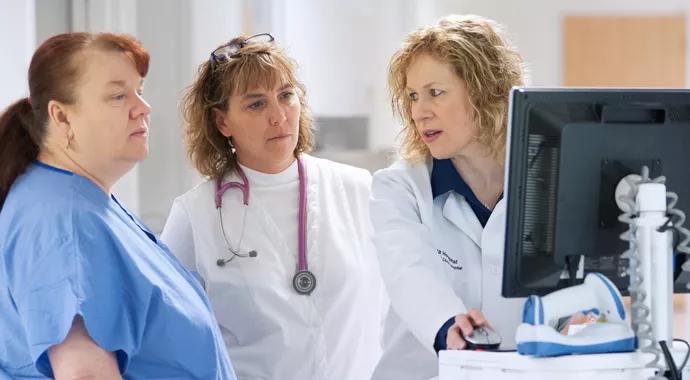
Image content: This image is available to view online.
View image online (https://assets.clevelandclinic.org/transform/0e5ea2fb-2fe1-4610-a5ae-1af2f82abe9b/prodevelop_690x389_jpg)
prodevelop_690x389
When Medina Hospital became part of the Cleveland Clinic healthcare system in 2009, nurse leaders at the regional hospital south of Cleveland were excited by the opportunities for professional development offered by Cleveland Clinic. “Professional development is vital for nurses,” says Kathy Burns, DNP, RN, CNS, CEN, clinical nurse specialist at Medina Hospital. “Advances in medicine and the ever-changing landscape of healthcare necessitates continuous learning to keep pace with evidence-based practices and standards of care.”
Advertisement
Cleveland Clinic is a non-profit academic medical center. Advertising on our site helps support our mission. We do not endorse non-Cleveland Clinic products or services. Policy
While Cleveland Clinic has a comprehensive professional development program for nurses, including a Career Ladder to promote advancement and numerous continuing education options, many of the 250 RNs at Medina Hospital remained disengaged. So the regional hospital’s Professional Development Council, which has 16 members representing most nursing units, decided to ramp up promotions of professional development activities. Its goal was to boost participation in the Career Ladder program, promote continuous learning and recognize nursing accomplishments.
In 2012, only six percent of nurses at Medina Hospital were enrolled in an RN-to-BSN program and six percent in an MSN program. In addition, just 47 nurses had advanced a level on the Nursing Institute’s Career Ladder and 49 nurses were certified. “There are a lot of great nurses here at Medina Hospital,” says Annie Damm, BSN, RN, a perioperative staff nurse at the hospital and a member of the Professional Development Council. “But it’s hard to know what path to take or how to advance your career. Support is very important.”
The Professional Development Council instituted several methods to promote professional development, including the following:
Advertisement
Aside from these activities, the Professional Development Council launched a quarterly newsletter called “Nursing GPS: Goals, Professionalism, Success.” It lists nursing award winners and Career Ladder recipients, presents information on continuing education and certification review courses, highlights upcoming nursing conferences and more.
Perhaps the biggest influence on nurses is the personal support from peers. For instance, a member of the Professional Development Council who works in the ICU encouraged her peers to join their professional organization, the American Association of Critical Care Nurses, and arranged a group discount on membership fees. And some of the nurses who joined have since become involved in the local chapter.
All of these efforts have made a difference at Medina Hospital. In 2014, 19 percent of nurses were enrolled in an RN-to-BSN program, 19 percent in an MSN program and 21 percent in a doctorate program. In addition, by 2013 the number of certified nurses at the hospital increased to 57, and 65 nurses advanced a level on the Career Ladder.
These achievements benefit not only the nurses, but patients too. “Maintaining competence and expanding knowledge and skills through education contributes to improved quality of care at the bedside,” says Burns.
Advertisement
Advertisement
Nurses play key role in comprehensive lifetime treatment program
Customized bots improve speed, efficiency by streamlining daily clinical, clerical tasks

Nurses play pivotal role in patients’ ability to recover in the comfort of their own homes
New protocol reduces costs, increases patient and caregiver satisfaction

Advocating for patient safety is imperative in fast-paced surgical settings

M-Power program improves the perinatal experience for people who have survived abuse

Advice for those pursuing a WOC nursing career

Veteran nurse shares his experience as a caregiver and community volunteer
 Search