Locations:





The Vascular Surgery Blog
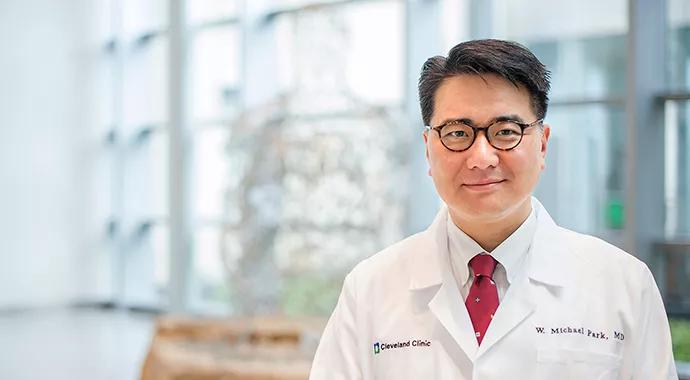
Image content: This image is available to view online.
View image online (https://assets.clevelandclinic.org/transform/3f998247-3599-46dd-96cc-1d317454bacd/park_sculpture_690x3801_jpg)
Coffman 083887 05-01-14
Written By: W. Michael Park, MD
Advertisement
Cleveland Clinic is a non-profit academic medical center. Advertising on our site helps support our mission. We do not endorse non-Cleveland Clinic products or services. Policy
Since joining Cleveland Clinic in 2012, one of my duties includes interviewing future vascular surgeons applying for residency and fellowship positions. One of the questions we frequently ask is, “Why did you choose vascular surgery?” The most common answer– and my reason for choosing this field– is the variety within vascular surgery. There are very few surgical specialties that truly operate all over the body, in the young, the middle aged and the old and vascular happens to be one of them. The answer I rarely get, but have learned to appreciate even more, is about the constancy of change within vascular surgery.
The technology of medicine has kept pace with Moore’s Law, and every aspect of vascular surgery has been affected by this. (Moore’s Law is a 1970s technical term stating that processing power for computers doubles every two years.) It used to be said that you could practice vascular surgery from the moment you graduated without learning a single new technique or procedure, staying faithful to the principles learned during fellowship. Today, that kind of orthodoxy is wishful thinking at best, and the struggle with the challenges of the new has been a hallmark of practicing modern vascular surgery for the better part of two decades. One of the epicenters of that change has been Cleveland Clinic.
So why is it that we can offer good, if not great, results for severe vascular conditions? How is a culture of cooperation and unit cohesion fostered and maintained? What brings and keeps so many practitioners (12 on main campus, 14 regionally) “under one roof”? (It’s not the Cleveland weather.) What is the role of cutting edge medicine in a time of budget cuts? What is it like to be a patient here?
Advertisement
I hope to answer some of these questions in this blog. Welcome.
Advertisement
Advertisement

A sampling of outcome and volume data from our Heart & Vascular Institute

Concomitant AF ablation and LAA occlusion strongly endorsed during elective heart surgery

Large retrospective study supports its addition to BAV repair toolbox at expert centers

Young age, solid tumor, high uptake on PET and KRAS mutation signal risk, suggest need for lobectomy

Surprise findings argue for caution about testosterone use in men at risk for fracture

Residual AR related to severe preoperative AR increases risk of progression, need for reoperation

Findings support emphasis on markers of frailty related to, but not dependent on, age

Provides option for patients previously deemed anatomically unsuitable
 Search