Locations:





Minimally invasive procedures relieve symptoms and can be done in outpatient settings
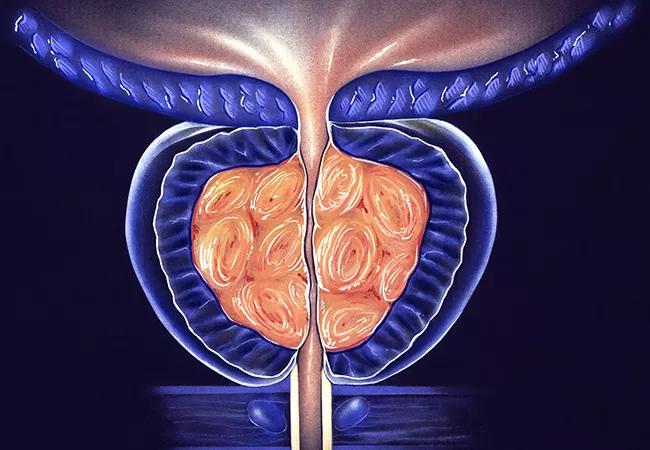
Image content: This image is available to view online.
View image online (https://assets.clevelandclinic.org/transform/672fa8c3-b4c6-4e7e-b411-95cfb8d10155/22-URL-2717137-CQD-650x450-1_jpg)
Prostate Gland – (BPH) Benign Prostatic Hyperplasia, Stage 3
Benign prostatic hyperplasia (BPH) is ubiquitous in men older than 50 and, with increasing age, causes lower urinary tract symptoms that affect quality of life. In recent years, minimally invasive surgical treatments have joined drug therapy and surgical resection as therapeutic options.
Advertisement
Cleveland Clinic is a non-profit academic medical center. Advertising on our site helps support our mission. We do not endorse non-Cleveland Clinic products or services. Policy
Minimally invasive surgical treatments for BPH have shown promise in terms of efficacy and patient comfort. They cause less tissue damage, can be done in an outpatient setting, are less costly, and allow for quick recovery. The most common side effects include post-procedure urinary frequency and short-lived discomfort.
The prostatic urethral lift, achieved with the UroLift device, is a minimally invasive surgical technique that Cleveland Clinic urologists have been using since 2015. Andrew Altman, MD, of the Glickman Urological & Kidney Institute, uses the UroLift® device for patients in his Twinsburg, Ohio, practice.
The UroLift procedure compresses the enlarged prostate lobes that surround and narrow the urethra, widening the urethra to facilitate urination. Under mild sedation and with the aid of cystoscopy, the urologist inserts a delivery device, or sheath, into the urethra. When the sheath reaches the prostatic urethra, a needle, which houses a small implant, is ejected into the prostatic lobe. The implant consists of a nitinol capsular tab, a retractable PET suture, and a stainless steel urethral end piece. The needle is deployed through the prostatic lobe and capsule. When the needle is retracted, the capsular tab is deposited under tension with a suture. The implant is secured by the urethral end piece and the suture is then cut. The number of implants ranges from two to eight depending on the size of the patient’s prostate.
Generally, a younger man whose prostate weighs 80 grams or less is an ideal candidate for the procedure. The diagnostic and screening workup involves three outpatient tests:
Advertisement
Urodynamic examination for real-time analysis of the patient’s average and maximum flow, how much urine remains in the bladder after voiding, and pressure generated by the bladder in the storage and voiding phases.
Cystoscopy to confirm that the problem is prostatic and not caused by urethral stricture, a bladder stone, or a tumor. Cystoscopy defines the type of prostatic growth; ie, whether it is bilobar or trilobar, or whether there is intravesicular extension of prostate tissue growing or pushing into the bladder.
Transrectal ultrasound to determine the prostate size. Treatment for a 40-gram prostate would differ from that needed for an 80- or 180-gram prostate.
“Various treatment options are available to the patient depending on the size and anatomy of his prostate,” says Dr. Altman. “The patient is a candidate for UroLift if bladder contractile function is present, the prostate size is less than 80 grams, and the hyperplasia is bilobar. If there is a large middle lobe, UroLift isn’t an option.”
An advantage of UroLift is that it can be done in the outpatient setting without a general or spinal anesthetic. But UroLift is just one option, notes Dr. Altman. Medication is a good choice for many patients. Some might opt for transurethral resection of the prostate (TURP). Others might prefer laser vaporization of prostate tissue.
UroLift alleviates BPH symptoms, but does not result in the same urine flow rate that patients experience after TURP. The more invasive surgical procedures provide better symptom relief, but they are not appropriate for every patient.
Advertisement
“This is a quality-of-life issue that requires shared decision-making,” says Dr. Altman. “On completion of the workup, we discuss our findings and review the treatment options with the patient, who makes the final decision.”
The procedure takes 10-15 minutes and patients go home the same day, 80% of them without a catheter. Possible aftereffects include short-lived urinary frequency and some discomfort. Because the bladder neck and urethra are left intact, there is little risk of incontinence or retrograde ejaculation— complications of other BPH surgical procedures. Sexual function is preserved.
Because of the lifting and separating effects of the implants, urination improves almost immediately. The improvement in lower urinary tract symptoms associated with BPH is durable for up to eight years.
Advertisement
Advertisement
Clinicians should individualize dosing practices based on patient risk factors and preferences
Pioneering and refining the approach in pyeloplasty, nephrectomy and more
Fully-automated process uses preop CT, baseline GFR to estimate post-nephrectomy renal function
Could mean earlier treatment, but also could have negative effects

Unlike earlier pills, new drugs do not cause liver toxicity
Male factors play a role in about half of all infertility cases, yet men often are not evaluated
Surgeons choreograph nearly simultaneous procedures, sharing one robot between two patients

Identifying barriers in the renal genetic assessment of Black patients
 Search