Locations:





Study provides first evidence of improved outcomes in this setting
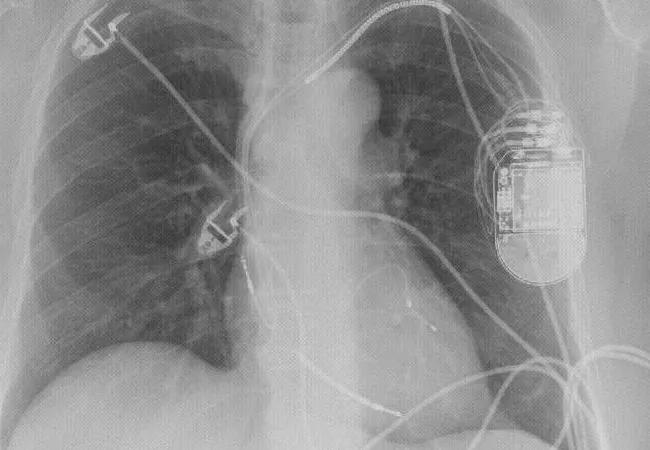
Image content: This image is available to view online.
View image online (https://assets.clevelandclinic.org/transform/4267d216-a684-49c5-ad2a-d71d88917348/20-HVI-2013163_cardiac-resynchronization-therapy_650x450_jpg)
20-HVI-2013163_cardiac-resynchronization-therapy_650x450
Cardiac resynchronization therapy (CRT) can be a valuable treatment option even in patients with severe left ventricular dysfunction, concludes a new retrospective study published online in JACC: Clinical Electrophysiology.
Advertisement
Cleveland Clinic is a non-profit academic medical center. Advertising on our site helps support our mission. We do not endorse non-Cleveland Clinic products or services. Policy
“CRT is well established for heart failure patients with reduced left ventricular ejection fraction (LVEF), yet the mean LVEF in clinical trials of CRT was 20% to 30%,” says lead author John Rickard, MD, MPH, of Cleveland Clinic’s Section of Cardiac Electrophysiology and Pacing.
He notes that patients with very low LVEF — i.e., 15% or less — have been underrepresented in clinical trials, so the effect of CRT in this population has been unknown. “We normally send these patients for CRT, but we really didn’t know whether it was helping them,” Dr. Rickard explains. “Ours is the first study to offer convincing evidence that this is the right thing to do.”
He and colleagues at Cleveland Clinic and Johns Hopkins identified 420 patients with an LVEF ≤ 15% and a QRS duration ≥ 120 ms who had undergone implantation of a CRT device at their institutions between April 2003 and May 2014.
“It took two centers to amass enough patients in this population to do this study,” Dr. Rickard notes.
Models for multivariate analysis were developed to identify factors associated with CRT response, which was defined as an absolute improvement in LVEF of > 5% and survival without need for heart transplant or left ventricular assist device (LVAD) implantation. Heart transplant and LVAD placement were assessed through chart review; mortality was assessed by searching various public and private databases.
The cohort’s mean (± SD) baseline LVEF was 13.2% ± 2.4%. Over mean follow-up of 5.2 years, 17 patients received LVADs, 20 underwent heart transplant and 254 died.
Advertisement
Of the initial cohort, 298 patients had both a pre-CRT echocardiogram and an appropriately timed follow-up echocardiogram. Of these, 145 (48.7%) experienced an absolute improvement in LVEF of 5% or more.
Moreover, improvement in LVEF translated into significantly better outcomes. Multivariate analysis showed that smaller left ventricular end-diastolic diameter was independently associated with improved survival free of LVAD or heart transplant, as were left bundle branch block, younger age and female sex.
No procedural deaths occurred across the cohort.
According to Dr. Rickard, these insights into the impact of CRT in patients with very low ejection fraction offer reassurance that electrophysiologists may proceed with confidence in this population. “We should be aggressively offering CRT in these patients,” he says.
He adds that a meaningful improvement in LVEF (> 5% absolute increase) was achieved in nearly one out of three patients (30.4%) with the greatest ventricular dilation — i.e., a left ventricular end-diastolic diameter ≥ 7.8 cm. “We are even helping some of these patients, but not to the same extent as patients with higher LVEFs,” he says.
The fact that no procedure-related deaths were found was a relief, Dr. Rickard notes. “It confirms that the CRT implantation process appears to be safe,” he says. “When you sedate someone with such little heart function, it is always a concern.”
These findings appear to indicate there may be no point at which left ventricular function becomes so poor that CRT may not be helpful. “Patients with severe left ventricular dysfunction benefit from CRT, albeit at lower rates than patients with higher LVEFs,” Dr. Rickard concludes. “Moving forward, we are more likely to offer CRT to appropriate patients with low LVEF.”
Advertisement
His colleague Oussama Wazni, MD, Chair of Cardiac Electrophysiology and Pacing, concurs. “This study lends confidence to cardiologists to offer CRT to some of our sickest patients,” he says.
Advertisement
Advertisement

A sampling of outcome and volume data from our Heart & Vascular Institute
Concomitant AF ablation and LAA occlusion strongly endorsed during elective heart surgery
Large retrospective study supports its addition to BAV repair toolbox at expert centers
Young age, solid tumor, high uptake on PET and KRAS mutation signal risk, suggest need for lobectomy
Surprise findings argue for caution about testosterone use in men at risk for fracture
Residual AR related to severe preoperative AR increases risk of progression, need for reoperation

Findings support emphasis on markers of frailty related to, but not dependent on, age
Provides option for patients previously deemed anatomically unsuitable
 Search