Locations:





Retrospective study finds dramatic reduction relative to nonsurgical controls
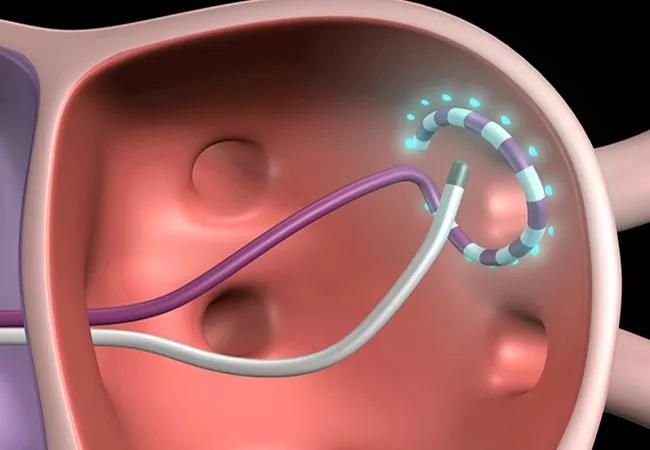
Image content: This image is available to view online.
View image online (https://assets.clevelandclinic.org/transform/1110f545-7966-4652-b2d3-7c6c77518487/19-HRT-3929-AF-ablation-650x450_jpg)
19-HRT-3929-AF-ablation-650×450
Patients with severe obesity who have symptomatic atrial fibrillation (AF) should be considered for bariatric surgery before undergoing AF ablation, concludes a new retrospective Cleveland Clinic study. The study, published by Europace (2019 Jul 15 [Epub ahead of print]), found a greater than threefold reduction in AF recurrence over three years in patients who underwent bariatric surgery prior to ablation compared with control patients who did not.
Advertisement
Cleveland Clinic is a non-profit academic medical center. Advertising on our site helps support our mission. We do not endorse non-Cleveland Clinic products or services. Policy
“It is well established that bariatric surgery leads to many short- and long-term cardiovascular benefits,” says senior author Walid Saliba, MD, Director, Cleveland Clinic Atrial Fibrillation Center. “This study indicates that such surgery can also help reduce recurrence of atrial fibrillation following ablation.”
Dr. Saliba explains that obesity is an independent risk factor for developing AF and is also associated with a host of factors that may promote arrhythmias, including hypertension, obstructive sleep apnea, insulin resistance, inflammation, coronary artery disease and elevated epicardial fat volume. Weight loss following bariatric surgery has been associated with improvements in many of these risk factors, and small studies have associated it with reduced AF events.
The new investigation, a retrospective observational cohort study, assessed 239 consecutive patients with morbid obesity (body mass index [BMI] > 40 kg/m2, or > 35 kg/m2 with obesity-related complications) who underwent ablation for AF at Cleveland Clinic between 2010 and 2016. Patients had been followed clinically for a mean of 22 months before ablation.
The study arms consisted of 51 patients who had bariatric surgery prior to ablation and 188 who were enrolled in medical weight-management clinics. Mean BMI across the entire cohort at the time of ablation was 41.1 ± 5.3 kg/m2.
Patients were followed for a mean of 36 months after ablation. The study found the following:
Advertisement
These associations between bariatric surgery and reduced AF recurrence and repeat ablation remained significant after multivariable and propensity score-based analyses.
“Additionally, following ablation, AF was reclassified from persistent to paroxysmal in 22% of patients who underwent bariatric surgery versus none of those who did not,” notes the study’s lead author, Eoin Donnellan, MD, a cardiovascular medicine fellow at Cleveland Clinic.
Several pre-ablation factors were identified that significantly increased the risk of AF recurrence following ablation:
The authors note that this study adds to mounting evidence of the cardiovascular benefits associated with obesity reduction demonstrated in other investigations, including the Cleveland Clinic-led STAMPEDE trial (N Engl J Med. 2012;366:1567-1576). That randomized controlled study found that diabetes risk factors significantly improved following bariatric surgery, with benefits still enduring through five-year follow-up (N Engl J Med. 2017;376:641-651).
Advertisement
“This new study by Drs. Saliba, Donnellan and colleagues adds to the existing literature by indicating that bariatric surgery is associated with a dramatically reduced rate of recurrent AF following ablation in patients with morbid obesity,” observes Steven Nissen, MD, a senior investigator with the STAMPEDE trial and Chief Academic Officer of Cleveland Clinic’s Miller Family Heart & Vascular Institute. “It is the first reported study to show a reduction in post-ablation recurrence rates in the wake of bariatric surgery.”
“Ideally, these results should be confirmed in a multicenter randomized controlled trial,” notes Oussama Wazni, MD, Section Head of Electrophysiology and Pacing at Cleveland Clinic. “In the meantime, however, we would recommend that individuals with treatment-refractory morbid obesity consider evaluation for bariatric surgery before AF ablation, as the overall evidence for cardiovascular benefits is strong.”
Advertisement
Advertisement

A sampling of outcome and volume data from our Heart & Vascular Institute
Concomitant AF ablation and LAA occlusion strongly endorsed during elective heart surgery

Large retrospective study supports its addition to BAV repair toolbox at expert centers
Young age, solid tumor, high uptake on PET and KRAS mutation signal risk, suggest need for lobectomy
Surprise findings argue for caution about testosterone use in men at risk for fracture
Residual AR related to severe preoperative AR increases risk of progression, need for reoperation

Findings support emphasis on markers of frailty related to, but not dependent on, age
Provides option for patients previously deemed anatomically unsuitable
 Search