Locations:





Ostial flaring delivers three-year patency comparable to that of covered stents
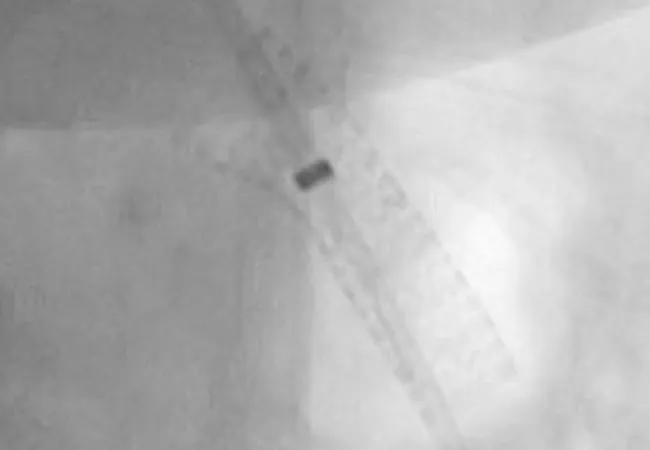
Image content: This image is available to view online.
View image online (https://assets.clevelandclinic.org/transform/80b85f93-32d5-4efa-8f7f-bcb9b6ca3ce3/19-HRT-5584_Lyden_650x450_jpg)
flared balloon-expandable stent in superior mesenteric artery
Use of ostial flaring techniques during endovascular stent placement in the superior mesenteric artery (SMA) for chronic mesenteric ischemia (CMI) has put patency outcomes for bare metal stents on par with those for covered stents, which are significantly more expensive devices. So finds a retrospective review of Cleveland Clinic experience (J Vasc Surg. 2019 Jul 18 [Epub ahead of print]), which also shows that outcomes of endovascular therapy in this setting have steadily improved over time.
Advertisement
Cleveland Clinic is a non-profit academic medical center. Advertising on our site helps support our mission. We do not endorse non-Cleveland Clinic products or services. Policy
“In the current era of advanced endovascular techniques, bare metal stents deliver patency that’s comparable to that with covered stents in the treatment of chronic mesenteric ischemia,” says Sean Lyden, MD, Cleveland Clinic’s Chair of Vascular Surgery and senior author of the study. “Our experience indicates that choosing the more costly option is no longer defensible without evidence from a randomized comparative study.”
Although open surgical bypass remains the gold standard for treating CMI, endovascular interventions are justified on the basis of a lower risk of morbidity and mortality. But clear evidence is lacking on whether covered stents — which cost three to five times more than bare metal stents — should be standard for endovascular therapy.
An earlier review of 225 patients from 2000 to 2010 (J Vasc Surg. 2013;58:1316-1323) found better outcomes with covered stents (92% primary patency at three years, vs. 52% with bare metal stents), but the covered stent data were based on only nine patients.
From 2003 to 2014 at Cleveland Clinic, 150 patients with CMI underwent a bare metal endovascular intervention on the celiac axis (56 vessels) or the SMA (133 vessels), with 38 patients undergoing concurrent interventions to both. In addition to the overall results, early (2003-2008) and late (2009-2014) cohorts were separately analyzed.
“We leveraged our experience with fenestrated stent grafting to flaring visceral stents to allow for better ostial expansion and easier retreatment of restenosis during this period,” notes Dr. Lyden. Over the study period, this approach was adopted for the majority of the procedures, rising from 44% in the early cohort to 72% in the late cohort.
Advertisement
Celiac axis. Overall, primary patency was 86% at one year and 66% at three years. Secondary patency at three years was 100%. Univariate analysis for demographics, atherosclerotic risk factors, presenting symptoms, stent diameter and ostial flaring revealed no significant differences. No differences were found between outcomes from the early and late periods.
SMA. Overall, primary patency was 81% at one year and 69% at three years; secondary patency was 96% at three years. The following trends were found at three years:
After multivariate analysis, ostial flaring was the only factor found to be associated with improved SMA patency at three years (HR = 0.29; 95% CI, 0.12-0.69; P = .006).
Because only seven patients received a covered stent during the study period, their numbers were insufficient for inclusion in the analysis. “However, our data suggest contemporary outcomes for flared bare metal stents in the SMA position have excellent results and do not justify use of covered stents,” Dr. Lyden observes.
Advertisement
According to the authors, important conclusions from the review include the following:
“The increasing use of endovascular techniques as an alternative to open surgery for treating chronic mesenteric ischemia makes it critical to monitor outcomes data and continue to develop refinements,” concludes Dr. Lyden.
Advertisement
Image at top reprinted from Haben et al., Journal of Vascular Surgery 2019 Jul 18 [Epub ahead of print], with permission from the Society for Vascular Surgery.
Advertisement
Advertisement

A sampling of outcome and volume data from our Heart & Vascular Institute
Concomitant AF ablation and LAA occlusion strongly endorsed during elective heart surgery

Large retrospective study supports its addition to BAV repair toolbox at expert centers
Young age, solid tumor, high uptake on PET and KRAS mutation signal risk, suggest need for lobectomy

Surprise findings argue for caution about testosterone use in men at risk for fracture
Residual AR related to severe preoperative AR increases risk of progression, need for reoperation

Findings support emphasis on markers of frailty related to, but not dependent on, age
Provides option for patients previously deemed anatomically unsuitable
 Search