Locations:





How clear, concise language can bridge the gap between providers and patients
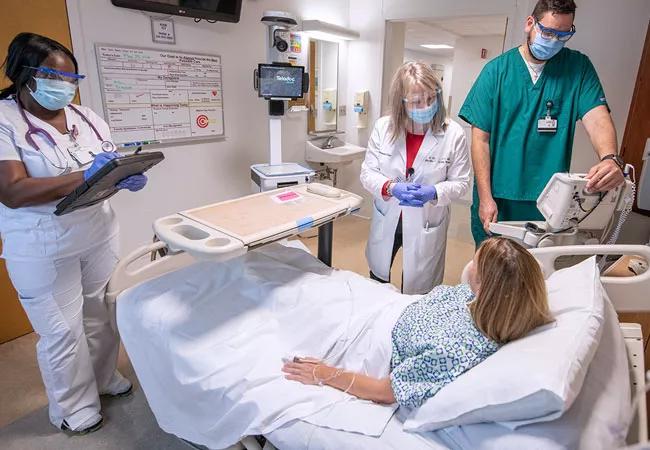
Image content: This image is available to view online.
View image online (https://assets.clevelandclinic.org/transform/c635d395-faf9-4c7c-9036-bcbf00cc2664/23-NUR-3726661-MedicalJargon-CQD_650x450_jpg)
23-NUR-3726661-MedicalJargon-CQD_650x450
Courtney Genovese, RN, recalls standing at the bedside of a man whose physician was explaining a new diagnosis. The patient, whose face grew increasingly confused and concerned as the doctor spoke, eventually turned to Genovese and plaintively asked, “You’ll explain it to me later, right?”
Advertisement
Cleveland Clinic is a non-profit academic medical center. Advertising on our site helps support our mission. We do not endorse non-Cleveland Clinic products or services. Policy
As the manager of Care Management at Cleveland Clinic Hillcrest Hospital, Genovese is frequently asked to help with complex cases when patients and their families are struggling to understand what providers are telling them. The longtime nurse has become particularly adept at mitigating the conflicts that can arise when clinicians rely too heavily on medical jargon to convey important information. Although this verbal shorthand may be second nature to caregivers, Genovese explains that it can be quite confusing to patients and their families – especially those facing a serious diagnosis or stressful procedure.
“It’s critical to remember that patients may be totally unfamiliar with the medical terms that providers use every day,” she explains. To avoid miscommunication, Genovese encourages caregivers to break down complex ideas – including lab results, diagnoses and next steps – and describe them in the most basic of terms.
Conversely, she urges providers to steer clear of needlessly complicated words when conveying a diagnosis or treatment plan.
“Terms like ‘ambulate’ instead of ‘walk’ and ‘erythematous’ instead of ‘red’ can lead to misunderstandings and put unnecessary distance between caregivers and their patients,” she explains. “On the other hand, simple, clear language improves communication and empowers patients to make better decisions about their own healthcare.”
Genovese also cautions clinicians to avoid casual comments that can be easily misinterpreted or taken out of context.
Advertisement
“For example, a caregiver may walk into a patient’s room and say something seemingly straightforward like, ‘Your potassium is up today.’ Unfortunately, that remark might make the patient think they should avoid eating bananas,” she explains. “It’s quite common for people to draw false conclusions when they don’t understand how a particular symptom or lab value relates to the disease process.”
Poor or rushed communication can also cause frustration and diminish trust, leaving patients and families feeling disrespected or mistreated, she adds. Furthermore, confusion can lead patients to seek answers from unreliable sources.
“When patients are too embarrassed or confused to ask follow-up questions, they may turn to Google or Wikipedia for answers – but that can be misleading and risky,” she says. “Although there’s a wealth of information available online, it may not always be the right information – and the internet certainly doesn’t understand the nuances of an individual patient’s illness.”
Abbreviations are another frequent source of frustration, explains Genovese. In her department, for example, it’s common for providers to refer patients to skilled nursing facilities — “SNFs” for short.
“One patient mentioned that a caregiver had told her to ‘pick a sniff,’ from a typed list of facilities,” she recalls. “Unfortunately, she didn’t understand the term and had no idea what she was being asked to do.”
Even common abbreviations like CHF (congestive heart failure) and AFib (atrial fibrillation) may confuse patients, who can be quickly overwhelmed by the “alphabet soup” that is so ubiquitous in clinical settings. Genovese suggests caregivers take time to spell out acronyms and explain what they mean in plain language.
Advertisement
“Patients come to us with varying degrees of medical literacy – and, unfortunately, some have a poor understanding of their own health,” she says. “It’s our job to teach them, advocate for their well-being and create a safe environment where they feel comfortable asking questions. The use of clear, unambiguous language is one of the most effective ways to bridge that gap.”
Genovese explains that there are scenarios in which clear communication is especially important. This includes moments when providers are delivering serious news or describing next steps to patients.
“For example, a patient who has just learned they have cancer may not have the emotional bandwidth to absorb why they’re being sent home or what outpatient treatment will entail,” she explains. In such cases, she says caregivers should slow down and confirm that the patient is tracking each part of the conversation.
Clarity is especially important when administering medications, says Genovese, who urges nurses to tell their patients what drugs they’re giving them and why.
“Routine statements like, ‘I’m going to give you this heparin shot,’ seem self-explanatory to those of us who are familiar with the drug and its indications, but these scenarios can be unsettling to patients who are unclear about what they’re receiving and why,” she says.
Rather than merely listing the drugs a patient is about to receive, Genovese suggest caregivers try a brief, reassuring explanation such as, ‘I’m giving you heparin, which is something we give to patients undergoing certain kinds of surgeries to reduce the risk of blood clots.”
Advertisement
“Straightforward, practical information can be enormously comforting,” she adds.
Finally, Genovese says providers can reduce uncertainty and improve communication by bringing the entire clinical team together for high-stakes conversations.
“When you’re sharing important information with a patient or family, it’s critical that nothing is misinterpreted,” she says. “Having the medical team fully present allows the family to get the answers they need. And if one provider happens to stumble over their words, another can step in with a clearer explanation.”
Advertisement
Advertisement

Nurses play key role in comprehensive lifetime treatment program
Customized bots improve speed, efficiency by streamlining daily clinical, clerical tasks
Nurses play pivotal role in patients’ ability to recover in the comfort of their own homes
New protocol reduces costs, increases patient and caregiver satisfaction

Advocating for patient safety is imperative in fast-paced surgical settings

M-Power program improves the perinatal experience for people who have survived abuse

Advice for those pursuing a WOC nursing career

Veteran nurse shares his experience as a caregiver and community volunteer
 Search