Locations:





New system uses vital signs to predict need for further intervention

Image content: This image is available to view online.
View image online (https://assets.clevelandclinic.org/transform/ab4c5bf2-d3b8-487b-9f25-7efbe5295528/23-NUR-3534824-NN-Rsrch-SAVES-CQD-2_650x450_jpg)
23-NUR-3534824-NN-Rsrch-SAVES-CQD-2_650x450
Cleveland Clinic has implemented a new tool that alerts caregivers to the early signs of clinical deterioration in pediatric patients. The automated system – Situational Awareness Vital Electronic Scout (SAVES) — was designed to circumvent the limitations of the Pediatric Early Warning Score (PEWS), a widely used yet error-prone screening approach.
Advertisement
Cleveland Clinic is a non-profit academic medical center. Advertising on our site helps support our mission. We do not endorse non-Cleveland Clinic products or services. Policy
“With PEWS, patient care nursing assistants would take a patient’s vital signs and manually input them into the electronic health record [EHR]. Unfortunately, manual errors such as transposed data could go unnoticed,” explains Carla Anderson, MSN, APRN, CCRN-K, CPN, Pediatric Clinical Nurse Specialist at Cleveland Clinic Children’s.
“In the past, a clinical nurse would ideally calculate the PEWS within an hour of taking the patient’s vital signs. However, time-sensitive interventions could be jeopardized if the scoring process was ever delayed.”
Recognizing a need for greater immediacy, Anderson assembled an internal, multidisciplinary team dedicated to finding a solution. The result was SAVES, a system embedded in the EHR that translates designated vital sign values into a color-coded risk-stratification score:
• Green – Continue routine vital signs and scoring.
• Blue – Perform a SAVES-focused nursing assessment.
• Yellow – Huddle and develop a mitigation plan; take vital signs and reassess the patient every two hours or per mitigation orders.
• Red – Initiate an immediate evaluation by a physician/licensed independent practitioner and/or activate an appropriate emergency response team.
Anderson explains that although her team drew inspiration from Vital Scout™, an existing algorithm used to evaluate adult patients for clinical deterioration, SAVES was designed to use vital sign parameters that are specific to pediatric patients.
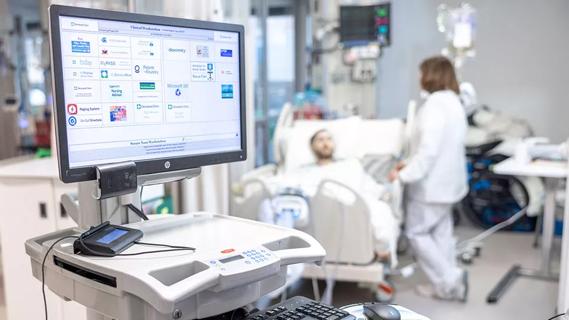
Scores are displayed on screen savers in unit workstations so caregivers have immediate and constant access to the data.
Advertisement
“Pediatric patients aren’t simply miniature adults; there are a host of special physiological and emotional considerations that come into play when managing a child,” explains Anderson. “Illnesses and injuries affect pediatric patients in unique ways; SAVES is intended to address some of those differences, which can significantly affect how children should be treated.”
Anderson began her study by conducting a retrospective EHR review of pediatric patients admitted to Cleveland Clinic Children’s main campus non-ICU nursing units over an eight-year period. Her primary goal was to ascertain whether SAVES could identify a higher level of patient acuity than PEWS based on redefined warning levels. (SAVES’ two warning levels were combined into one to make it easier to compare to PEWS, which has one warning level.)
Kris Kormos, FP-C, a Clinical Systems Analyst at Cleveland Clinic, worked with Anderson to apply the SAVES framework to existing PEWS data gathered from the EHR. Any errors were then corrected based on accurate data, resulting in a revised PEWS for each patient. This allowed Kormos to compare original and revised PEWS with SAVES. Patient data were evaluated in three ways: all data encounters per admission, first encounter per admission and one randomly selected encounter per admission.
Among its key findings, the study showed that PEWS may be less accurate than SAVES. Furthermore, SAVES appears to improve the identification of pediatric patients with slow clinical deterioration. Although the tool has been validated, Anderson stresses that caregivers must continue to think critically about patients’ hemodynamic data and clinical status while trusting their gut instinct about when and how to escalate care.
Advertisement
Anderson, who presented her research at the National Association of Clinical Nurse Specialists annual conference in March, says the project also highlights how advanced practice registered nurses can be at the forefront of change.
“Nurses are in a unique position to lead the development, implementation, evaluation and improvement of clinical programs,” she says. “No one has a more intimate understanding of patient needs than we do, so it’s wonderful when we have an opportunity to make a difference — and potentially save a life.”
Advertisement
Advertisement

Nurses play key role in comprehensive lifetime treatment program
Customized bots improve speed, efficiency by streamlining daily clinical, clerical tasks

Nurses play pivotal role in patients’ ability to recover in the comfort of their own homes
New protocol reduces costs, increases patient and caregiver satisfaction

Advocating for patient safety is imperative in fast-paced surgical settings

M-Power program improves the perinatal experience for people who have survived abuse

Advice for those pursuing a WOC nursing career

Veteran nurse shares his experience as a caregiver and community volunteer
 Search