Locations:





Researchers urge adding evaluation of atria when assessing patients for cardiac amyloidosis
Image content: This image is available to view online.
View image online (https://assets.clevelandclinic.org/transform/42678191-3dc6-4401-99ed-4c35bc9bdafb/22-HVI-2954581-CQD-967x544-1_jpg)
cardiac scintigraphy image
Atrial uptake of technetium-99m-pyrophosphate (99mTc-Pyp) with cardiac scintigraphy is associated with both existing atrial fibrillation (AF) and its development within one year. So finds a retrospective analysis of 580 Cleveland Clinic patients published in Circulation: Cardiovascular Imaging.
Advertisement
Cleveland Clinic is a non-profit academic medical center. Advertising on our site helps support our mission. We do not endorse non-Cleveland Clinic products or services. Policy
The researchers say this insight is important for (1) recognizing the increased likelihood of AF in patients undergoing cardiac scintigraphy for transthyretin cardiac amyloidosis (ATTR-CA) and (2) identifying the possible presence of cardiac amyloidosis in patients with AF, especially in the elderly or those with no risk factors for AF. Both scenarios can help promote earlier treatment and thereby improve outcomes.
“With increasing use of cardiac scintigraphy, we have found that it’s important not to overlook the presence of atrial uptake of 99mTc-Pyp because of its strong association with atrial fibrillation,” says the study’s corresponding author, Patrick Collier, MD, PhD, a cardiologist in Cleveland Clinic’s Section of Cardiovascular Imaging. “We need a low threshold to begin anticoagulation for patients with cardiac amyloidosis, as they form thrombi independent of standard risk scores.”
Traditionally thought to be a rare disease, ATTR-CA is increasingly recognized, especially with the modern use of cardiac scintigraphy with 99mTc-Pyp, a calcium binder traditionally used as a nuclear imaging agent for bone. More recently, its value for diagnosing ATTR-CA has emerged, as ventricular myocardial uptake of 99mTc-Pyp — reflecting the presence of micro-calcifications in the ventricle — noninvasively makes the diagnosis and distinguishes the ATTR form from the light chain form of cardiac amyloidosis.
Although atrial uptake of 99mTc-Pyp assessment is currently not part of the clinical evaluation of ATTR-CA, Cleveland Clinic cardiologist Wael Jaber, MD, another author of this study, noticed that atrial tissue lit up in some patients undergoing the test. Later examining clinical records, he saw that many of them had AF.
Advertisement
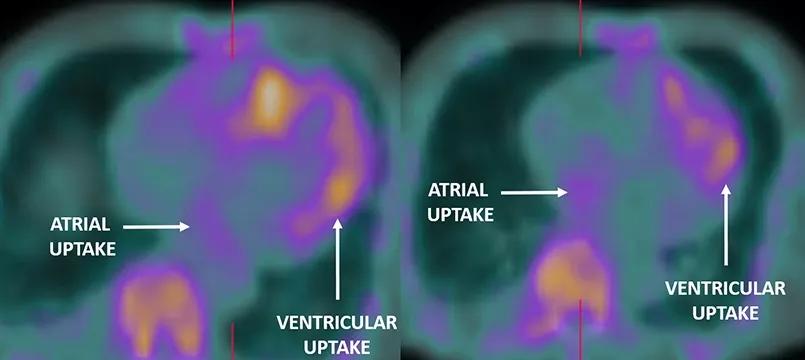
Image content: This image is available to view online.
View image online (https://assets.clevelandclinic.org/transform/deac8a97-6fb7-4237-9877-7fd0c22543e2/22-HVI-2954581-CQD-inset_jpg)
Cardiac scintigraphy with 99mTc-PyP-labeled bone-seeking tracers in a patient with ventricular and atrial uptake.
These observations led to a series of investigations on the significance of atrial uptake of 99mTc-Pyp by this research team that includes experts in amyloidosis, cardiac pathology, imaging and electrophysiology. In a recent research correspondence letter to JACC: Clinical Electrophysiology, they reported their finding that atrial uptake of 99mTc-Pyp predicts arrhythmia recurrence following ablation for AF.
“Knowing that many patients with ATTR-CA also have atrial fibrillation, we set out to evaluate the relationships between atrial uptake of 99mTc-Pyp, ATTR-CA and atrial fibrillation,” says Dr. Jaber. “Could atrial uptake be an independent predictor of risk that we should be paying attention to?”
The cohort of their latest study comprised 580 patients who underwent cardiac scintigraphy with 99mTc-Pyp at Cleveland Clinic between January 2012 and September 2019 for suspected ATTR-CA. Images were reviewed retrospectively, with the readers blinded to the presence or development of AF and pathology results. AF was considered present if it existed at the time of the scan or developed within a year after.
Overall, 51% of patients had a diagnosis of AF, 28% had scans indicative of ATTR-CA and 20% had atrial uptake of 99mTc-Pyp. Patients with atrial uptake were older than the rest of the cohort (median age of 77 vs. 74 years) but were no different in terms of sex, cardiovascular risk factors, kidney function or NT-proBNP level.
Advertisement
Associations between atrial uptake, ATTR-CA and AF included the following:
Multivariable analysis revealed that two factors were independently associated with AF:
In contrast, ATTR-CA diagnosis, sex, smoking, hypertension, diabetes, left ventricular ejection fraction and coronary artery disease were not independently associated with AF.
Of note, micro-calcifications were detected with histopathology in all atrial and ventricular tissue with amyloid deposits, and no micro-calcifications were detected in patients with non-amyloid dilated cardiomyopathy.
“Actually seeing dense micro-calcifications for the first time in atrial tissue of patients with ATTR-CA was both surprising and fascinating, especially to me as an imaging cardiologist,” Dr. Collier remarks. “It may have implications for the earlier diagnosis of ATTR-CA, which has never been more important now that we have effective novel therapies.”
He adds that ATTR-CA was much more common than he and his colleagues had expected in elderly patients who had undergone scintigraphy, especially as the disease is traditionally viewed as rare. “As a result, ATTR-CA should be included in the differential diagnosis of very elderly patients with atrial fibrillation, especially in those with any red flags for amyloidosis,” he urges.
Advertisement
The investigators note that their findings open up multiple new avenues for investigation, including further defining which patients with AF are at increased risk of ATTR-CA, whether patients with atrial uptake should be actively screened for AF and perhaps even preemptively treated for it, and whether areas of atrial uptake might be good treatment targets.
“We are in the early phases of studying whether managing ATTR-CA will be helpful in decreasing the burden of atrial fibrillation,” adds Oussama Wazni, MD, MBA, Section Head of Cardiac Electrophysiology and Pacing at Cleveland Clinic.
Advertisement
Advertisement

A sampling of outcome and volume data from our Heart & Vascular Institute
Concomitant AF ablation and LAA occlusion strongly endorsed during elective heart surgery
Large retrospective study supports its addition to BAV repair toolbox at expert centers
Young age, solid tumor, high uptake on PET and KRAS mutation signal risk, suggest need for lobectomy
Surprise findings argue for caution about testosterone use in men at risk for fracture
Residual AR related to severe preoperative AR increases risk of progression, need for reoperation

Findings support emphasis on markers of frailty related to, but not dependent on, age
Provides option for patients previously deemed anatomically unsuitable
 Search