Locations:





How it fits into today’s cholesterol-lowering practice
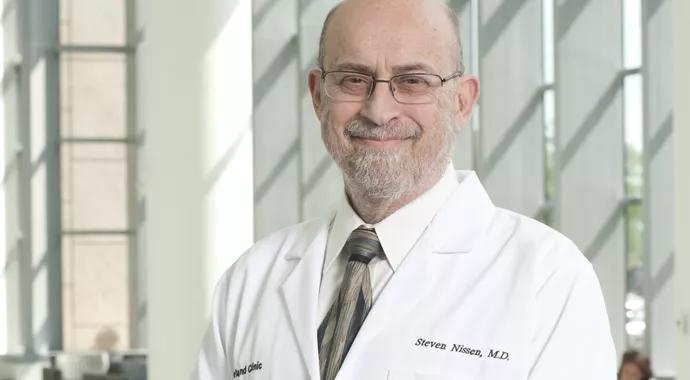
Image content: This image is available to view online.
View image online (https://assets.clevelandclinic.org/transform/83f95f14-8b64-40d8-b0cb-a0c56851d4f1/NissenPCSK9-690x380_jpg)
NissenPCSK9-690×380
The FDA’s approval in late July of the first PCSK9 inhibitor, alirocumab, is a major event in cardiovascular medicine. This new class of monoclonal antibodies heralds a new era of powerful cholesterol-lowering agents, says Steven Nissen, MD, Chair of the Robert and Suzanne Tomsich Department of Cardiovascular Medicine at Cleveland Clinic.
Advertisement
Cleveland Clinic is a non-profit academic medical center. Advertising on our site helps support our mission. We do not endorse non-Cleveland Clinic products or services. Policy
The FDA approved alirocumab as additive therapy along with diet and maximally tolerated statin therapy in adults with heterozygous familial hypercholesterolemia (HeFH) or patients with clinical atherosclerotic cardiovascular disease who require additional lowering of LDL cholesterol (LDL-C). PCSK9 inhibitors in combination with statin therapy are capable of lowering LDL-C by as much as 50 to 70 percent (see earlier coverage here).
In this video, Dr. Nissen discusses the therapeutic possibilities opened up by this new class of injectable agents, including the ability to treat patients cardiologists haven’t been able to treat effectively in the past, such as those with HeFH.
“The approval by the FDA of the first PCSK9 inhibitor is a major event in cardiovascular medicine… Even patients with LDL-C levels of over 200 can get to very desirable levels of LDL-C with the combination of statins and PCSK9 inhibitors,” he explains.
He also provides insights about alirocumab’s labeling as combination therapy with statins, and what the future could hold when ongoing clinical outcome trials of PCSK9 inhibitors are complete — most likely by 2017. The FDA’s “approval is as an add-on to statins, not as a replacement,” he notes. “The FDA was careful in choosing the language in the label because they believe that with all of the great outcome data with statins, PCSK9 inhibitors should not be given without a statin.”
Video content: This video is available to watch online.
View video online (https://www.youtube.com/embed/72K7TOK26Ro?rel=0&wmode=transparent)
Advertisement
Advertisement
A sampling of outcome and volume data from our Heart & Vascular Institute
Concomitant AF ablation and LAA occlusion strongly endorsed during elective heart surgery
Large retrospective study supports its addition to BAV repair toolbox at expert centers
Young age, solid tumor, high uptake on PET and KRAS mutation signal risk, suggest need for lobectomy
Surprise findings argue for caution about testosterone use in men at risk for fracture
Residual AR related to severe preoperative AR increases risk of progression, need for reoperation

Findings support emphasis on markers of frailty related to, but not dependent on, age

Provides option for patients previously deemed anatomically unsuitable
 Search