Locations:





Large new analysis argues for rethinking current guidelines
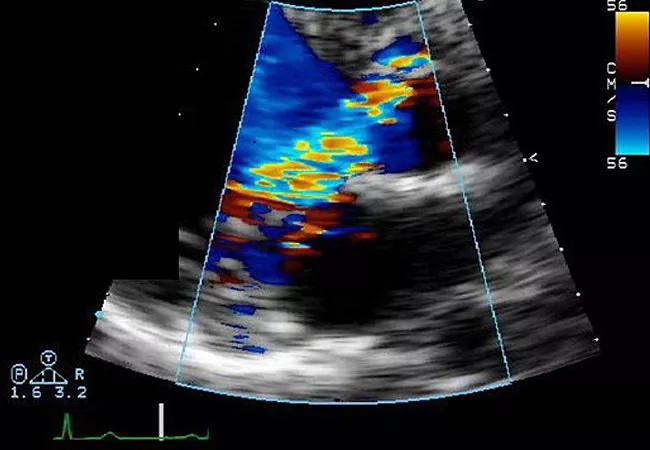
Image content: This image is available to view online.
View image online (https://assets.clevelandclinic.org/transform/f71fb32d-fcc2-4704-8188-5288c16d79a6/17-HRT-221-Aortic-Regurg-LVEF-CQD-650p_jpg)
17-HRT-221-Aortic-Regurg-LVEF-CQD-650p
Aortic valve surgery at a high-volume center significantly improves long-term survival in patients with chronic severe aortic regurgitation (AR) even if they have minimal or no symptoms and preserved left ventricular function (LVEF).
Advertisement
Cleveland Clinic is a non-profit academic medical center. Advertising on our site helps support our mission. We do not endorse non-Cleveland Clinic products or services. Policy
So concludes an unprecedentedly large observational cohort study of a contemporary group of Cleveland Clinic patients with grade III or greater AR and preserved LVEF, as reported in the Journal of the American College of Cardiology (JACC) in late 2016. The study’s findings, if replicated, argue for revision of current recommendations for the timing of aortic valve surgery based on left ventricular dimensions in this patient population, the authors note.
“Patients with severe AR typically remain asymptomatic for a very long time, yet a number of studies show that subclinical LV myocardial dysfunction occurs early in the compensated stage with preserved LVEF, before overt symptoms develop and guideline-recommended thresholds for surgery are reached,” says principal author Milind Desai, MD, a Cleveland Clinic cardiologist and Professor of Medicine at Cleveland Clinic Lerner College of Medicine. “We conducted this study to reassess thresholds for interventions in such patients, as current guidelines are based on much smaller studies from more than two decades ago.”
Dr. Desai and colleagues identified 1,417 patients with grade III or greater chronic AR and preserved LVEF (≥ 50 percent) evaluated at Cleveland Clinic from 2003 through 2010; all patients were asymptomatic (87 percent) or had only mild symptoms. The researchers had three objectives:
Advertisement
Key cohort characteristics were as follows:
Two-thirds of the cohort (n = 933) underwent aortic valve surgery, at a median of 55 days after baseline echocardiogram, while 484 patients (34 percent) did not undergo aortic valve surgery. Nearly three-quarters of aortic valve surgeries were valve replacements, with the rest being valve repairs; 36 percent were isolated aortic valve procedures.
In-hospital postoperative mortality was low, at 2 percent overall and 0.6 percent for isolated aortic valve procedures.
Over a mean follow-up of 6.6 ± 3 years across the cohort, 262 patients (19 percent) died. Major findings included the following:
Advertisement
“Long-term survival in the subgroup undergoing aortic valve surgery was not only significantly better than in those who didn’t undergo surgery; it was statistically comparable to that of an age- and sex-matched U.S. population without aortic regurgitation,” notes Dr. Desai.
Study co-author Brian Griffin, MD, adds that these findings challenge current AHA/ACC guidelines that recommend aortic valve surgery for AR only in symptomatic patients, in the setting of depressed LVEF, or in the setting of a dilated LV or an LV end-systolic diameter > 5 cm or indexed diameter > 2.5 cm/m2.
“Those recommendations were based largely on small studies with short follow-up conducted over 20 years ago,” says Dr. Griffin, Cleveland Clinic’s Section Head of Cardiac Imaging. “They may need to be revisited in our current age of advanced diagnostic and surgical techniques and improved postoperative care.”
An accompanying editorial in JACC by Jeffrey Borer, MD, of SUNY Downstate Medical Center echoes that sentiment and notes this study’s points of distinction, including a sample size nearly five times the size of the next-biggest study on this question. “Moreover,” Dr. Borer writes, “the nonsurgical cohort provided substantial information about the natural history of severe AR without aortic valve replacement,” noting that its size was “almost one-half as many as the total of all previous long-term nonsurgical natural history studies from multiple institutions over > 30 years.”
The sample size reflects Cleveland Clinic’s high volumes of AR cases and aortic valve surgeries, observes study co-author Lars Svensson, MD, PhD, Chair of Cleveland Clinic’s Miller Family Heart & Vascular Institute. “There’s a need to underscore the importance of a multidisciplinary management strategy, including the availability of the full spectrum of surgical options, at a highly experienced center like ours to the ability to achieve the outcomes reported here,” Dr. Svensson notes.
Advertisement
“Moreover,” he adds, “at Cleveland Clinic 70 percent of patients with bicuspid aortic valves can undergo aortic valve repair, and 90 to 95 percent of patients with root aneurysm can have aortic valve repair and keep their own valves. In our hands, the mortality risk is 0.47 percent for a bicuspid valve repair and 0.17 percent for elective aortic root preservation with aortic valve repair and reimplantation.”
The fact that outcomes like this have been reported out of a very high-volume center bolsters the imperative to replicate the current study’s findings, concludes the editorial by Dr. Borer. “This excellent study argues for increased efforts to conduct randomized controlled trials for valve surgery, a need long recognized and now ready for prime time,” he writes.
Advertisement
Advertisement
A sampling of outcome and volume data from our Heart & Vascular Institute
Concomitant AF ablation and LAA occlusion strongly endorsed during elective heart surgery
Large retrospective study supports its addition to BAV repair toolbox at expert centers
Young age, solid tumor, high uptake on PET and KRAS mutation signal risk, suggest need for lobectomy
Surprise findings argue for caution about testosterone use in men at risk for fracture
Residual AR related to severe preoperative AR increases risk of progression, need for reoperation

Findings support emphasis on markers of frailty related to, but not dependent on, age
Provides option for patients previously deemed anatomically unsuitable
 Search