Locations:





Study of ACGME case log data spurs proposals to reverse the trend
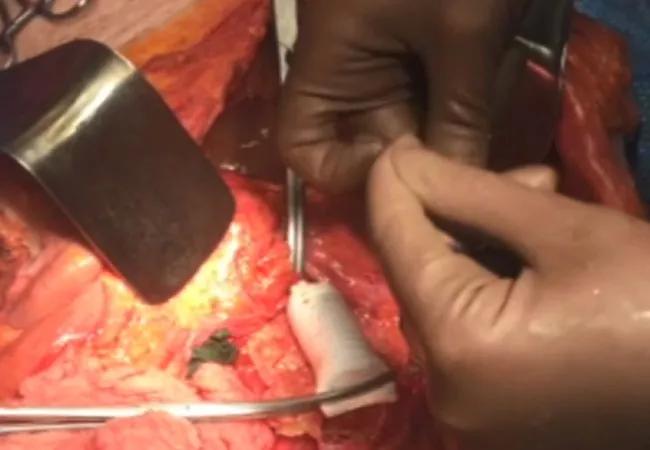
Image content: This image is available to view online.
View image online (https://assets.clevelandclinic.org/transform/290879e6-2b02-4a09-b2db-9d9b5090cc1c/20-HVI-1979451-open-vascular-surgery_650x450_jpg)
20-HVI-1979451-open-vascular-surgery_650x450
The advent of endovascular aneurysm repair (EVAR) in the 1990s increased demand for learning this technique and shifted focus away from open surgical procedures. As a case in point, a recent review of Medicare data (J Vasc Surg. 2018;67:1690-1697) revealed that open abdominal aortic aneurysm (AAA) repairs fell by 76% from 2003 to 2013 while EVAR volumes nearly doubled.
Advertisement
Cleveland Clinic is a non-profit academic medical center. Advertising on our site helps support our mission. We do not endorse non-Cleveland Clinic products or services. Policy
The impact of this trend on training has been significant. At most academic medical centers, general surgery residents, vascular surgery fellows and vascular surgery integrated residents perform only a handful of open cases prior to completing their training program.
“If you have experience doing only five open aorta repairs, you’re not going to perform this surgery in your practice,” says Cleveland Clinic vascular surgeon Francis Caputo, MD.
Surgeons nationwide recognize this lack of experience as a problem. Cleveland Clinic vascular surgeons and fellows recently teamed up with colleagues in two other states to examine the type and number of cases performed by surgical trainees nationwide from 2000 through 2018 as tracked by the Accreditation Council for Graduate Medical Education.
Their findings, which focused on vascular surgery fellows and integrated residents as well as general surgery residents, were presented at the 2020 annual meeting of the Midwestern Vascular Surgical Society (MVSS), held virtually in September.
“We are seeing a general decline in open repair for all trainees in all areas of vascular surgery, including peripheral and cerebrovascular surgery, but what is most concerning is the drastic decline in open aortic aneurysm repair,” says Dr. Caputo, the study’s senior investigator. “The average number of femoral-popliteal bypass cases performed by vascular surgery trainees is in the single digits or low teens. The average number of open AAA repairs is just five to 10.”
Advertisement
The rise of EVAR has not obviated the need for open repair. In fact, 33% of AAA repairs performed at Cleveland Clinic between 2010 and 2014 were open surgeries, as reported by Cleveland Clinic staff last year (J Vasc Surg. 2019;70:921-926). On average, Cleveland Clinic vascular surgery residents perform 60 to 80 aortic surgeries per year during training, including 20 to 30 primary open AAA repairs.
“Open aortic surgery is still necessary in a large number of patients,” notes Cleveland Clinic Vascular Surgery Chair Sean Lyden, MD, a co-author of the study presented at the MVSS meeting. “With training in open procedures declining in most programs, patients are not going to be able to access this surgery unless they go to a regional referral center.”
Following their study’s confirmation that lack of training in open surgery is a national problem, Dr. Caputo and his colleagues proposed three potential solutions:
Advertisement
Advertisement

A sampling of outcome and volume data from our Heart & Vascular Institute
Concomitant AF ablation and LAA occlusion strongly endorsed during elective heart surgery
Large retrospective study supports its addition to BAV repair toolbox at expert centers
Young age, solid tumor, high uptake on PET and KRAS mutation signal risk, suggest need for lobectomy
Surprise findings argue for caution about testosterone use in men at risk for fracture
Residual AR related to severe preoperative AR increases risk of progression, need for reoperation

Findings support emphasis on markers of frailty related to, but not dependent on, age
Provides option for patients previously deemed anatomically unsuitable
 Search