Locations:





A large contemporary snapshot of rates and outcomes of CIED use
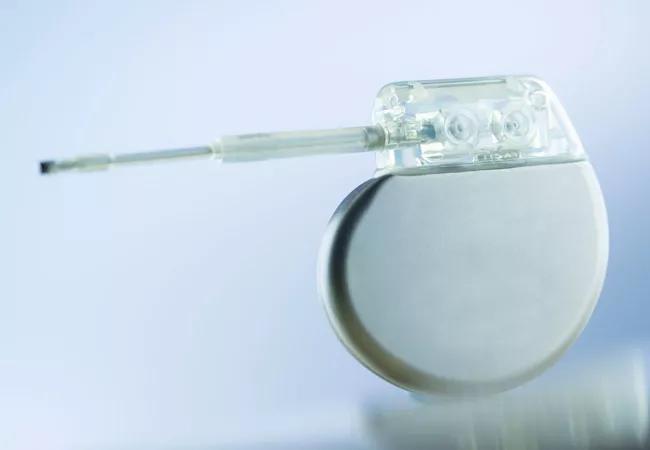
Image content: This image is available to view online.
View image online (https://assets.clevelandclinic.org/transform/cec211eb-d960-498d-82ed-cbba6943746b/16-HRT-2328-CIED-CQD-650x450_jpg)
cardiac implantable electronic device (CIED)
It’s a vexing conundrum: Most of the data on the risks of cardiac implantable electronic device (CIED) placement after open heart surgery come from studies that are now decades old. Yet as cardiac surgery patients’ ages and comorbidities continue to relentlessly increase, the applicability of those data diminishes with each passing year.
Advertisement
Cleveland Clinic is a non-profit academic medical center. Advertising on our site helps support our mission. We do not endorse non-Cleveland Clinic products or services. Policy
So a group of researchers led by electrophysiologist Khaldoun Tarakji, MD, MPH, responded by tapping into Cleveland Clinic’s vast Cardiovascular Information Registry to generate the most comprehensive snapshot of post-cardiac surgery CIED implantation in the contemporary era. Specifically, they analyzed all patients (N = 39,546) without a prior CIED implant who underwent cardiac surgery at Cleveland Clinic from 1996 to 2008 to:
Their findings, recently published online in Europace, represent “a long-overdue analysis of the rates of, reasons for and outcomes of post-cardiac surgery CIED use in the modern era,” says Dr. Tarakji, a staff cardiologist in Cleveland Clinic’s Section of Electrophysiology and Pacing.
Of the 39,546 surgery patients over the 12-year study period, 1,608 (4.1 percent) had a postoperative CIED implant before discharge: 1,107 received a permanent pacemaker and 501 received an implantable cardioverter-defibrillator (ICD).
“The incidence of CIED implantation after cardiac surgery remains low despite the aging of the population,” notes Dr. Tarakji.
The analysis showed that rates of CIED placement varied by type of operation. Rates were lowest (1.2 percent) for CABG alone, the sole non-valve operation category, and rose to a high of 25 percent for tricuspid valve replacement. Other operations with high rates of device placement were tricuspid valve repair and mitral valve replacement, with a rate of 12 percent each. Rates of device implantation also rose with each repeat operation, rising to 21 percent among patients who were undergoing a fifth cardiac surgery.
Advertisement
Conduction abnormalities accounted for the majority of CIED placements, although nearly a quarter of device recipients (23.1 percent) received their CIED for secondary prevention of ventricular arrhythmias.
Notable risk factors associated with the need for CIED implant were older age, left ventricular dysfunction, valvular disease, preoperative atrial fibrillation and prior cardiac surgery. “These findings align well with previous studies,” Dr. Tarakji observes.
In contrast, findings regarding survival were somewhat surprising, especially since information on long-term outcomes in post-surgery CIED recipients has traditionally been scarce.
The analysis showed CIED implantation to be associated with improved early survival but decreased late survival. Specifically, propensity-adjusted risk of early death (within one year) was significantly reduced among patients receiving CIEDs compared with patients not receiving CIEDs, with a hazard ratio (HR) of 0.38 (95% CI, 0.22-0.65). In contrast, propensity-adjusted risk of late death (beyond one year) was significantly higher in the CIED group (HR = 1.3; 95% CI, 1.2-1.5). These findings applied to both the permanent pacemaker and ICD subgroups of the CIED group.
The survival differences raise questions that demand further testing, Dr. Tarakji notes. In the meantime, he says, the differences underscore the need for careful follow-up: “Patients who receive a CIED after surgery require follow-up not only by their cardiologist but also by an electrophysiologist, to reassess their pacing needs and make adjustments as necessary.”
Advertisement
Dr. Tarakji says this analysis is valuable for the updated and comprehensive benchmark data it offers for patient counseling: “It can help take discussions of who may and may not need a device after surgery to a new level of accuracy.”
And the findings have applicability to percutaneous valve procedures as well. The 6.2 percent rate of CIED implantation after surgical aortic valve replacement in this analysis is lower than the permanent pacemaker implant rates from transcatheter aortic valve replacement (TAVR) registries, the study report notes.
“This provides a modern benchmark against which to compare rates of device implantation following transcatheter valve procedures,” Dr. Tarakji observes, adding that advances in transcatheter technologies “would hopefully reduce the need for pacemakers following TAVR.”
Advertisement
Advertisement
A sampling of outcome and volume data from our Heart & Vascular Institute
Concomitant AF ablation and LAA occlusion strongly endorsed during elective heart surgery
Large retrospective study supports its addition to BAV repair toolbox at expert centers
Young age, solid tumor, high uptake on PET and KRAS mutation signal risk, suggest need for lobectomy
Surprise findings argue for caution about testosterone use in men at risk for fracture
Residual AR related to severe preoperative AR increases risk of progression, need for reoperation

Findings support emphasis on markers of frailty related to, but not dependent on, age
Provides option for patients previously deemed anatomically unsuitable
 Search