Locations:





PM&R’s role in a traditional nursing domain
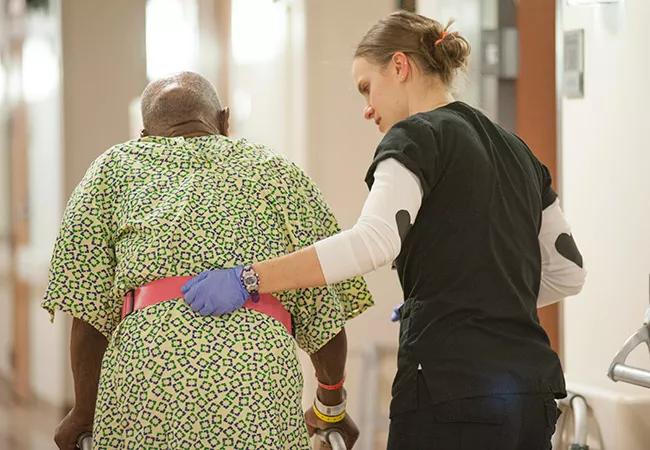
Image content: This image is available to view online.
View image online (https://assets.clevelandclinic.org/transform/cc981748-73ab-497b-9b64-46976db85070/16-NEU-999-Battu-Falls-650x450_jpg)
16-NEU-999-Battu-Falls-650×450
Falls prevention in the hospital is too important to be relegated largely to a single discipline. That was the notion behind the July 2015 launch of Cleveland Clinic’s Enterprise Falls Steering Committee, charged with equipping all caregivers — including physicians, therapists, nurses, pharmacists, care coordinators and others — to effectively prevent and manage patient falls throughout the continuum of care.
Advertisement
Cleveland Clinic is a non-profit academic medical center. Advertising on our site helps support our mission. We do not endorse non-Cleveland Clinic products or services. Policy
Cleveland Clinic leadership recognized that this quality committee for the overall Cleveland Clinic health system would benefit if it were directed by representatives of disciplines in addition to nursing, which has traditionally led falls-prevention efforts in many health systems. Physiatry was one natural area to turn to.
“As a physiatrist, I’m always taking a global view of the patient to help improve function,” says Sree Battu, MD, of the Department of Physical Medicine and Rehabilitation, who serves as co-chair of the falls steering committee. “I’m looking at medical issues, patient preferences and social determinants of care when caring for patients for the long term. So many factors are variables that can cause a fall, so it makes sense to adopt an interdisciplinary approach to managing falls.”
“Nursing has driven falls prevention campaigns for a long time, but the medical literature tells us you will be more successful reducing falls with an interdisciplinary approach,” adds the committee’s other co-chair, Dana Wade, DNP, RN, CNS-BC, CPHQ, NEA-BC, Associate Chief Nursing Officer of Nursing Quality and Practice. “Nurses may touch patients more, but we are all caregivers and we are all responsible for patient falls.”
Cleveland Clinic leadership decided to launch the falls steering committee with two primary goals in mind:
The steering committee’s first meeting last July brought together dozens of representatives from 26 areas across Cleveland Clinic health system, ranging from geriatrics and family practice to pharmacy and environmental services. Attendees discussed what they could contribute to falls prevention, from which the committee generated a long list of ideas and actions. Ideas were grouped for further work, and now more than 100 caregivers serve on the following six subcommittees that arose from those groupings: Care Environment, Data, Education and Communication, Medication Safety, Screening and Identification, and Transitions of Care.
Advertisement
“We are looking at our resources across the whole health system and approaching falls at the population level,” explains Wade, “just as you would for a group of patients with congestive heart failure or diabetes.”
At the same time, the initiative’s Patient Engagement Design Team found that patients wanted education surrounding falls to be individualized and consistent, as well as patient- and family-centered.
“Our mission is giving every caregiver the knowledge and tools to prevent falls,” says Dr. Battu. “We have a variety of initiatives to achieve that mission.”
Ideas developed within subcommittees are implemented at Cleveland Clinic’s main campus and its nine regional hospitals, four inpatient rehabilitation hospitals, skilled nursing facilities and more than 50 outpatient therapy venues — as well as through home care services.
Here’s a sampling of ongoing or completed projects undertaken by each of the subcommittees:
Advertisement
Three of the first ideas to make it to the hospital floor center on easily spotting at-risk patients: A yellow sign with a picture of a person falling is placed in high-risk patients’ rooms, and those patients wear a yellow wristband (see image at top of post) as well as yellow gripper socks.
While other changes may not be so visible, they are equally important. Paramount is the renewed focus on communication across caregiving disciplines. “Being part of a multidisciplinary team has been invaluable, as the entire team is now thinking in terms of the patient’s overall course of care more often and more comprehensively,” says Christine Schulte, PT, MBA, Outpatient Director of Cleveland Clinic Rehab and Sports Therapy. “The discussions we have surrounding the reasons for falls risk are critical: Is it a medication issue, a toileting issue, a strength issue, a vestibular issue or something else?”
The preliminary results of this holistic approach to falls prevention look promising. From the beginning to the end of 2015, falls resulting in serious injury decreased by one-third, according to Dr. Battu.
Although a large majority (about 70 to 80 percent) of patient falls result in no injury or harm, she notes that vigilance around falls prevention remains imperative for all. “Our mission is to improve the overall culture of safety by having all caregivers know what resources are available, how best to care for patients to avoid falls, and how to keep patients as safe as possible,” she says. “We’re optimistic that we’re well on our way.”
Advertisement
Advertisement
New study advances understanding of patient-defined goals
Testing options and therapies are expanding for this poorly understood sleep disorder
Real-world claims data and tissue culture studies set the stage for randomized clinical testing
Digital subtraction angiography remains central to assessment of ‘benign’ PMSAH

Cleveland Clinic neuromuscular specialist shares insights on AI in his field and beyond
Findings challenge dogma that microglia are exclusively destructive regardless of location in brain

Neurology is especially well positioned for opportunities to enhance clinical care and medical training
New review distills insights from studies over the past decade
 Search