Locations:





First-of-its-kind study validates AI approach to identify implants using X-rays
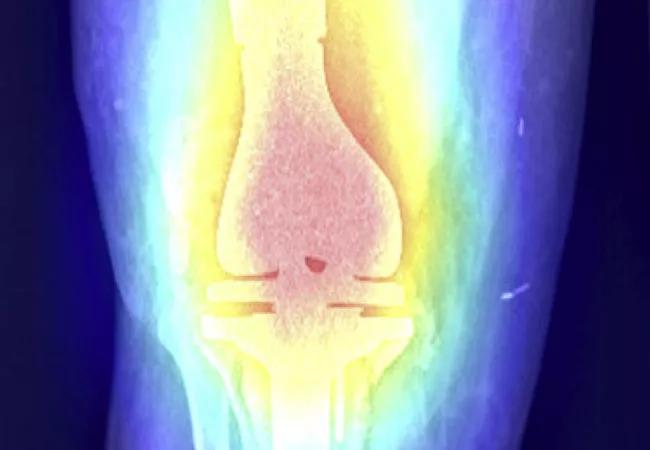
Image content: This image is available to view online.
View image online (https://assets.clevelandclinic.org/transform/7d5ffcc5-4168-46b9-90aa-72400813bc8d/21-ORI-2046036-CQD-Using-AI-to-Identify-Revision-Surgery-Hero_jpg)
21-ORI-2046036-CQD-Using-AI-to-Identify-Revision-Surgery-Hero
Using artificial intelligence (AI), orthopaedic surgeons at Cleveland Clinic were able to identify the manufacturer and model of an arthroplasty implant with 99% accuracy using plain x-rays alone.
Advertisement
Cleveland Clinic is a non-profit academic medical center. Advertising on our site helps support our mission. We do not endorse non-Cleveland Clinic products or services. Policy
Currently, the standard of care for identifying implants preoperatively is confirmed using prior operative reports, which may require reaching out to other healthcare systems that may or may not have this readily available, or through peer-to-peer crowdsourcing efforts. The process, the authors say, is long overdue due for improvement.
“Efficiency and resource utilization are sacrificed due to the lack of a streamlined method for preoperative implant identification,” says Prem Ramkumar, MD, MBA, lead author of the study and a chief resident in the Department of Orthopaedic Surgery at Cleveland Clinic.
Coupled with the rising revision arthroplasty volume as more total joint replacements are performed nationally and abroad, the issue won’t resolve anytime soon. Quaternary referral institutions, like Cleveland Clinic, are primed to handle the rising revision arthroplasty volume as a select center with the resources and expertise to handle the high degree of surgical complexity, along with the medical comorbidities associated with this patient population.
The existence of multiple implant manufacturers and various models in the growing orthopaedic device marketplace lends to increased difficulty in identifying the specific implant, further complicating preoperative planning.
Dr. Ramkumar and members of the Department of Orthopaedic Surgery designed two separate studies to classify knee and hip arthroplasty implants using a deep learning algorithm. Both studies were published in the Journal of Arthroplasty.
Advertisement
The Orthopaedic Machine Learning Lab, part of the Adult Reconstruction Center at Cleveland Clinic, was started by Dr. Ramkumar in collaboration with Viktor Krebs, MD. With Dr. Ramkumar coordinating and leading the study, the team trained, validated and externally tested the algorithm on retrospectively collected hip and knee anterior-posterior (AP) radiographs.
The knee dataset included 682 radiographs (424 patients) with implants from nine different models. The hip dataset included 1972 AP radiographs with 18 different models.
Using a metaphor to explain their approach, he remarks, “We knew the true identity of the postoperative X-rays using implant serial numbers and operative reports to feed the computer and build its implant ‘fund of knowledge.’ We then repetitively tested its knowledge through several hundred rounds of quizzes with both positive and negative reinforcement, and by the time it had ‘learned’ the implants, it got a 99% on the final exam.”
Remarkably, the deep learning algorithm discriminated the knee and hip implant models, respectively, with an area under the receiver-operating characteristic curve of 0.99. These findings didn’t surprise Dr. Ramkumar. Rather, he notes, they underscore the capacity for AI in the field of orthopaedics.
“These findings demonstrate the significance of marrying validated AI models with real-time, high-quality clinical data. We are seeing this across medicine, but this concept is still fairly novel within orthopaedics, particularly arthroplasty. We also have the uphill battle of convincing the uninitiated that this technique is superior to older statistical modeling methods, like regression analysis. Head-to-head with rich data, however, it’s really not a fair contest.” he asserts.
Advertisement
Jonathan Schaffer, MD, MBA, a joint and reconstructive surgeon at Cleveland Clinic and co-author of the papers, notes that with the right resources in place, this approach can be applied to any orthopaedic implant. “We have a high volume of patients with arthroplasty implants that are evaluated at Cleveland Clinic. This study helps lay a foundation that facilitates implant identification as soon as the radiographic image is available, saving valuable time and surgical scheduling, which at the end of the day, benefits patient care and optimizes resource utilization. Integration into electronic medical record and imaging archive systems are among the next steps,” he says.
Dr. Ramkumar notes that further investigation is imperative to train more implant models and prospectively validate AI models, but the team is encouraged with these results.
“Why are we depending on personnel experience and availability, when we have the technology that can do the job faster and more accurately? This saves time and resources while still maintaining a high standard of care.”
Advertisement
Advertisement
Biologic approaches, growing implants and more
Study reports zero infections in nearly 300 patients
How to diagnose and treat crystalline arthropathy after knee replacement
Study finds that fracture and infection are rare
Center will coordinate, interpret and archive imaging data for all multicenter trials conducted by the foundation’s Osteoarthritis Clinical Trial Network

Reduced narcotic use is the latest on the list of robotic surgery advantages
Cleveland Clinic specialists offer annual refresher on upper extremity fundamentals
Cleveland Clinic orthopaedic surgeons share their best tips, most challenging cases and biggest misperceptions
 Search