Locations:





High-intensity cycling program leads to improved walking capacity and upper extremity function
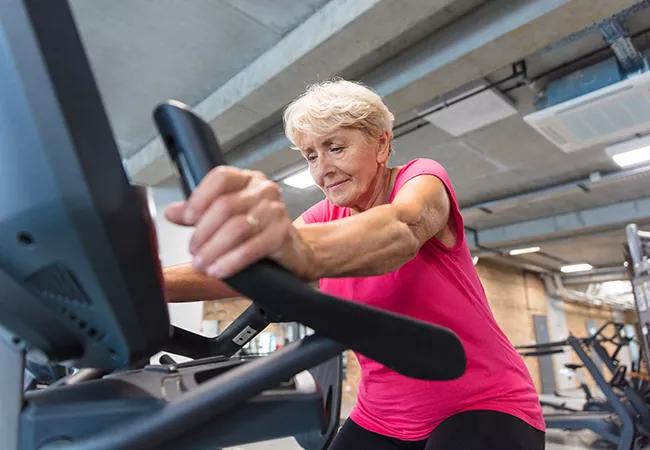
Image content: This image is available to view online.
View image online (https://assets.clevelandclinic.org/transform/6301b3a4-241a-4192-b02c-d2e4dd50f1b7/22-NEU-2927328_exercise-for-stroke-rehab_650x450_jpg)
Senior woman exercising on cycling machine at rehabilitation gym
Traditional thinking in the field of stroke rehabilitation is that to improve a skill, one must practice it. But a Cleveland Clinic research team is reshaping this principle with work showing that a program of aerobic cycling followed by upper extremity task practice leads to more profound gains than task practice alone.
Advertisement
Cleveland Clinic is a non-profit academic medical center. Advertising on our site helps support our mission. We do not endorse non-Cleveland Clinic products or services. Policy
“We are accumulating evidence that aerobic exercise changes brain function relevant to a variety of skills,” says Susan Linder, DPT, Director of Clinical Research in the Department of Physical Medicine and Rehabilitation at Cleveland Clinic, who is leading the stroke rehabilitation exercise research. “Stroke rehab for diverse functional goals can be significantly improved by incorporating a high-intensity exercise component.”
In 2010, Dr. Linder joined the laboratory of Jay Alberts, PhD, Vice Chair of Innovation in Cleveland Clinic’s Neurological Institute, where he was focusing on the effects of high-intensity cycling in people with Parkinson’s disease. Their findings were intriguing and significant: clinical improvements after exercise were comparable to those achieved by antiparkinson medications, and functional MRI showed that exercise caused the same pattern of brain activation as medications.
Dr. Linder, who had a career interest in stroke rehabilitation, wondered if the intervention might also benefit stroke patients. “We speculated that proteins released during exercise — such as brain-derived neurotrophic factor — have neuroplasticity-promoting effects on the brain that could enhance general skill acquisition in stroke patients,” she explains. “Could we create an intervention using aerobic exercise to prime the brain to improve upon benefits associated with traditional rehab?”
Like patients with Parkinson’s disease, stroke survivors are often unable to perform high-intensity exercise because of physical disability. To address this problem, Dr. Alberts’ team had designed a cycling system that allows patients to reach target aerobic and pedaling speed goals by pairing the patient with a healthy person on a tandem stationary bike. Later, an electric assist device was added to the bike, making a second person unnecessary.
Advertisement
“We don’t believe there’s anything unique about cycling per se,” notes Dr. Linder. “It just works well for research, as we can measure and control many exercise variables, and it entails a low risk of injury.”
The stroke intervention used by Dr. Linder’s team consists of 45 minutes of cycling followed 10 minutes later by upper extremity repetitive task practice. The team has conducted multiple clinical trials comparing one group undergoing assisted exercise, another doing self-generated exercise and a control group with no exercise component. All participants have experienced a single, unilateral stroke with residual upper extremity hemiparesis at least six months prior to the trials.
The studies have involved a program of three sessions per week for eight weeks. The two exercise groups underwent either assisted or unassisted cycling for 45 minutes, followed by 45 minutes of repetitive upper extremity task practice. Task practice for all groups was functional, goal-oriented and tailored to patient relevance and ability. For example, a patient might be instructed to pick up a cup and place it on a shelf. A typical session involved three to five tasks with a target of 70 to 100 repetitions of each task.
As reported in Neurorehabilitation and Neural Repair (2019;33[8]:681-690), the researchers found that while all groups realized functional improvement as assessed by standard measures of post-stroke motor recovery, the assisted exercise group had significantly greater gains than the other two groups.
Advertisement
Interestingly, achieving a pedaling cadence of 75 revolutions per minute better predicted benefit than did achieving the target aerobic capacity of 60% to 80% of maximum heart rate.
“It’s important to note that assisted exercise is not passive, as participants must actively contribute to the activity,” Dr. Linder points out. “Assisted exercise provides a consistent and more rapid exercise pattern than patients can accomplish on their own, and this appears critical to generate the physiological response needed for neuroplasticity.”
Other findings, published in the Archives of Physical Medicine and Rehabilitation (2021;102[1]:1-8), showed that stroke patients who underwent either cycling intervention significantly improved in 6-minute walk test performance while those in the control group declined. Again, higher pedaling cadence was associated with the greatest gains.
“We are currently evaluating walking mechanics of our participants and are finding that the quality of their walking has also improved with cycling,” Dr. Linder adds. “This suggests that aerobic exercise not only conditions the leg muscles and joints but also likely impacts brain control.”
Dr. Linder says her group’s ultimate goal is to develop a validated intervention that will be approved by insurers, allowing it to become standard practice in stroke rehabilitation. She notes that payers currently regard exercise as uncovered maintenance rather than covered therapy, and they argue that exercise can be conducted at home by the patient independently. She refutes these contentions, as the intervention requires a defined “dosage” and professional oversight to be conducted safely and effectively.
Advertisement
To bolster their case, Dr. Linder’s team is currently including cost-effectiveness measures in their studies. Participants are being followed for a year after the eight-week intervention and assessed for differences between intervention and control groups in the need for extended therapy and in outcomes such as clinical disability measures and recurrent stroke.
“Some rehabilitation therapists are already using aerobic exercise to supplement task practice, but they are limited by a lack of insurance coverage,” Dr. Linder observes. “We’d like to see an optimal exercise program available to everyone for whom the evidence demonstrates a likely benefit.”
Advertisement
Advertisement

New study advances understanding of patient-defined goals
Testing options and therapies are expanding for this poorly understood sleep disorder
Real-world claims data and tissue culture studies set the stage for randomized clinical testing
Digital subtraction angiography remains central to assessment of ‘benign’ PMSAH

Cleveland Clinic neuromuscular specialist shares insights on AI in his field and beyond
Findings challenge dogma that microglia are exclusively destructive regardless of location in brain
Neurology is especially well positioned for opportunities to enhance clinical care and medical training
New review distills insights from studies over the past decade
 Search