Locations:





Studying elbow injuries in baseball pitchers leads to new injury classification and surgical technique
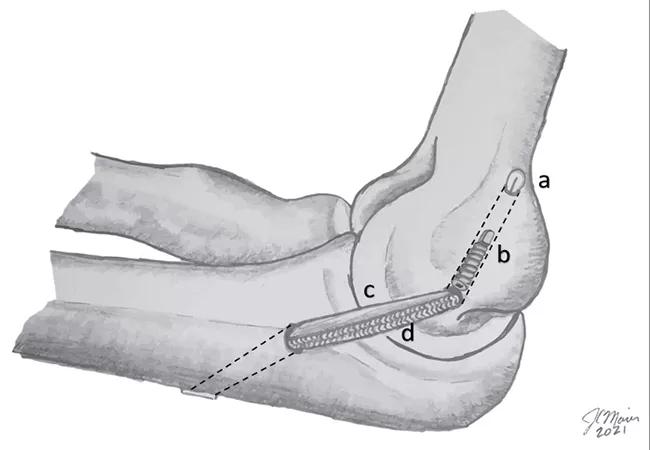
Image content: This image is available to view online.
View image online (https://assets.clevelandclinic.org/transform/7d3b0210-24b1-4a09-8016-fb3a7cf9c8ae/21-ORI-2418160-CQD-650x450_2_jpg)
21-ORI-2418160 CQD 650x450_2
By Salvatore Frangiamore, MD, and Mark Schickendantz, MD
Advertisement
Cleveland Clinic is a non-profit academic medical center. Advertising on our site helps support our mission. We do not endorse non-Cleveland Clinic products or services. Policy
Ulnar collateral ligament (UCL) injuries in throwing athletes are common and related to repetitive valgus stress on the medial elbow joint during the throwing motion. It is generally accepted that complete tears or avulsion injuries often require surgery, but how partial tears should be managed has been less clear.
In 2017, our team at Cleveland Clinic looked at MRI factors that led to failure in professional baseball pitchers with partial UCL tears and found that distal, ulnar-based tears were more likely to fail compared to proximal tears. To understand our results, we performed a histologic dye study to assess vascularity and found that the proximal UCL was well vascularized compared to the hypovascular distal UCL.
Next, in conjunction with the BioRobotics and Mechanical Testing Core at Cleveland Clinic’s Lerner Research Institute, we demonstrated that distal tears resulted in more gapping compared to proximal tears when a simulated valgus force was applied.
Based on these prior studies, we developed and validated an MRI-based classification system to help guide decision-making when considering treatment of partial UCL tears. Tears are classified by location (1 = proximal, 2 = midsubstance, 3 = distal) and subcategorized by grade (A = partial, B = complete) (Figure 1).
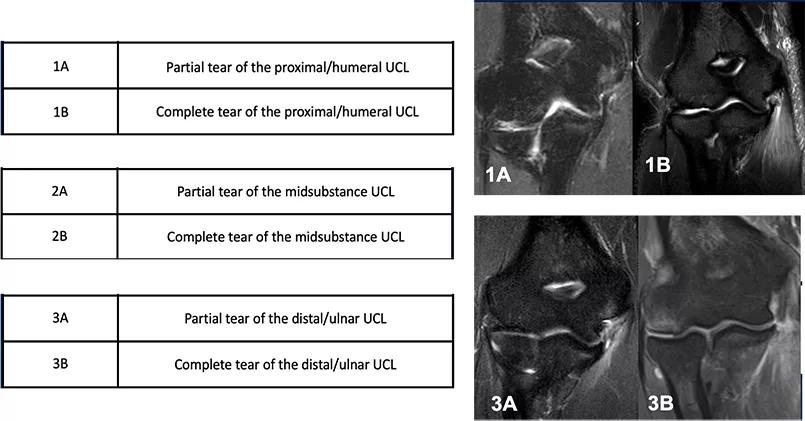
Image content: This image is available to view online.
View image online (https://assets.clevelandclinic.org/transform/3bcab9f6-93bd-42a2-9f93-7c7084353651/21-ORI-2418160-CQD-Inset-1_jpg)
Figure 1. UCL injury classification.
This classification system was found to be reliable and reproducible based on studies looking at inter- and intra-rater reliability. We also assessed its clinical utility by retrospectively applying it to a series of consecutive patients with UCL injuries and confirmed that proximal tears were less likely than distal tears to fail nonoperative management.
Advertisement
This classification system and its associated research were presented at Major League Baseball’s 2019 Winter Meetings, earning accolades for best research project.
Today we are testing a surgical technique that combines a novel UCL reconstruction method and internal bracing to reinforce the medial elbow after reconstruction (Figure 2). This technique uses dual suspensory fixation on the humerus and ulna to minimize the most common methods of failure: bone tunnel fracture and suture breakage. It also gives the surgeon better control of graft tensioning.
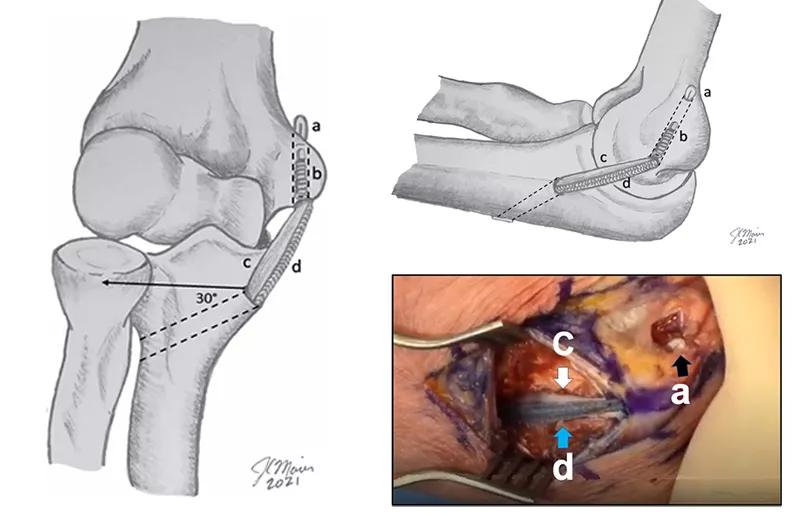
Image content: This image is available to view online.
View image online (https://assets.clevelandclinic.org/transform/bd88820f-610b-4f59-8cfc-841f4722b28a/21-ORI-2418160-CQD-Inset-2-1_jpg)
Figure 2. Novel adjustable, dual suspensory UCL reconstruction technique, demonstrating all-suture suspensory button (a), interference screw fixation (b), palmaris autograft (c) and internal brace (d).
We hypothesize that this technique, soon to be published in the Video Journal of Sports Medicine, can lead to improved outcomes in UCL reconstruction and may allow certain parts of the rehabilitation process to be expedited. A comparative biomechanical study in conjunction with the BioRobotics and Mechanical Testing lab will begin in the near future.
Drs. Frangiamore and Schickendantz are orthopaedic surgeons specializing in sports medicine at Cleveland Clinic’s Orthopaedic & Rheumatologic Institute. They both are team physicians for the Cleveland Guardians (formerly Cleveland Indians) Major League Baseball team, where Dr. Schickendantz is Director of Orthopaedic Services.
Advertisement
Advertisement
Biologic approaches, growing implants and more
Study reports zero infections in nearly 300 patients
How to diagnose and treat crystalline arthropathy after knee replacement
Study finds that fracture and infection are rare
Center will coordinate, interpret and archive imaging data for all multicenter trials conducted by the foundation’s Osteoarthritis Clinical Trial Network

Reduced narcotic use is the latest on the list of robotic surgery advantages
Cleveland Clinic specialists offer annual refresher on upper extremity fundamentals
Cleveland Clinic orthopaedic surgeons share their best tips, most challenging cases and biggest misperceptions
 Search