Locations:





Mobile unit cuts time to imaging and treatment, early data show
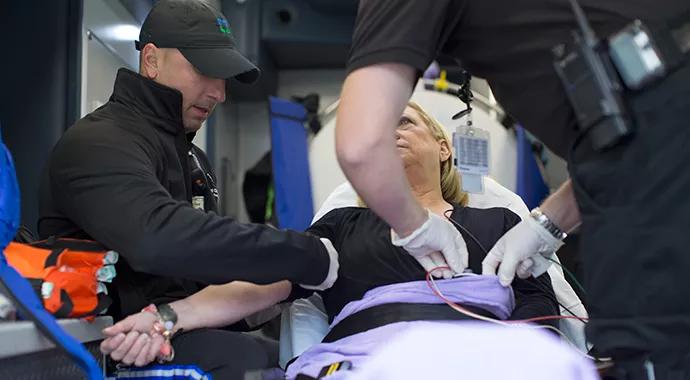
Image content: This image is available to view online.
View image online (https://assets.clevelandclinic.org/transform/5d624492-93c0-41b5-bc36-f2d18d10a566/690x380-Mobile-Stroke_jpg)
690×380-Mobile-Stroke
Not long ago, Cleveland Clinic’s Cerebrovascular Center faced a challenge that vexes stroke centers nationwide. Despite years of efforts to trim the time it takes to deliver potentially lifesaving tissue plasminogen activator (tPA) to ischemic stroke patients, rates of tPA delivery in the ER within the optimal three-hour window after symptom onset had plateaued at 17 percent.
Advertisement
Cleveland Clinic is a non-profit academic medical center. Advertising on our site helps support our mission. We do not endorse non-Cleveland Clinic products or services. Policy
While that compares favorably with national rates of approximately 5 percent, it wasn’t good enough for Cerebrovascular Center Director Peter Rasmussen, MD. “We felt we weren’t making enough of a difference in treating our patients in a timely fashion,” he says. “We needed to change the system.”
Dr. Rasmussen and colleagues had heard of a novel ambulance-like “mobile stroke unit” being used by a teaching hospital in Homburg, Germany, to shorten the time from stroke symptom onset to management, so they visited Germany in 2013 to check it out.
They were so impressed that the Cerebrovascular Center developed plans for Cleveland Clinic’s own mobile stroke treatment unit (MSTU), which they were able to realize when dedicated donor funding became available in 2014. When it began operations in July 2014, Cleveland Clinic’s MSTU became one of the first such units in the United States.
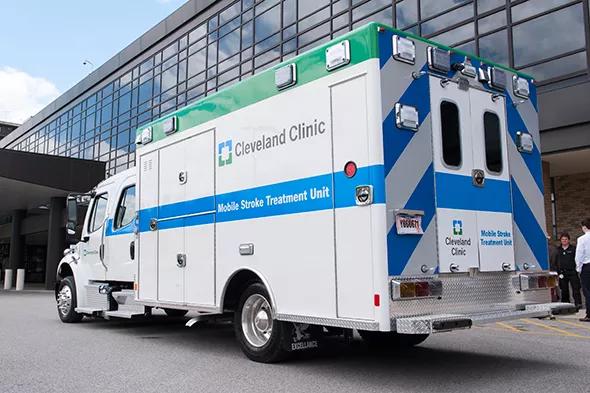
Image content: This image is available to view online.
View image online (https://assets.clevelandclinic.org/transform/88237634-9f6c-4c4a-ab88-278e190caaa1/590x-Inset-Mobile-Stroke_jpg)
The MSTU looks like an ambulance on the outside, but inside it’s equipped and staffed like a virtual ER dedicated to stroke diagnosis and management:
Advertisement
The approach allows the specialist physicians on the other end of the broadband video link to determine whether the patient is indeed having a stroke — and, critically, whether it is an ischemic or hemorrhagic event, which determines whether or not tPA is indicated.
As a result, crucial steps in stroke diagnosis and treatment can be accomplished at the site of stroke onset or while the patient is en route to the hospital, slashing intervention times for a condition where time equals brain.
The MSTU is based at Cleveland Clinic’s main campus and dispatched (along with a standard ambulance) via the city of Cleveland’s 9-1-1 system in cases of suspected stroke. When a stroke is diagnosed, the MSTU will transport the patient to the nearest Primary Stroke Center or Comprehensive Stroke Center.
“We’re essentially bringing the emergency room to the patient,” says Dr. Rasmussen. He notes that the use of telemedicine to allow neurologists to manage the case remotely, rather than on board the MSTU, was a Cleveland Clinic adaptation of the initial German model of the mobile unit.
In its first four months of operation, the MSTU transported more than 100 stroke patients to a total of 12 healthcare facilities across the greater Cleveland area. None of these patients had to be transferred to another facility, reducing unnecessary and expensive hospital transfers.
But the biggest benefit has been more timely patient management, as suggested by data presented in February at the American Stroke Association’s International Stroke Conference 2015. The data were from the first three weeks after the launch of Cleveland Clinic’s MSTU last summer, during which time 23 patients were treated in the MSTU, reported M. Shazam Hussain, MD, Head of Cleveland Clinic’s Stroke Program.
Advertisement
Compared with a matched control group of 34 stroke patients brought to the ER via traditional ambulance in the preceding three months, these first 23 patients treated in the MSTU experienced substantial reductions in time to CT completion and time to treatment. Specific findings were as follows:
Notably, a higher rate of tPA use was achieved in the MSTU group than in the control group (26 percent vs. 14 percent).
“In light of how critical time is in the treatment of stroke, the use of mobile stroke treatment units to provide pre-hospital evaluation and treatment should revolutionize the care of stroke patients,” said Dr. Hussain.
The results he reported are part of an ongoing study of a larger sample of experience with the MSTU, and future studies are planned to evaluate the unit’s effects on patient outcomes.
Although the MSTU initiative requires substantial investment — the mobile unit itself cost nearly $1 million, and it takes about $1 million a year to staff — Dr. Rasmussen anticipates it will save between $2 million and $4 million in its first year of operation, through savings in rehabilitation, long-term care and other aspects of post-acute stroke therapy.
“The beauty of this approach,” he says, “is that in addition to reducing patient injury and suffering, it should reduce overall healthcare costs.”
Advertisement
Advertisement

New study advances understanding of patient-defined goals
Testing options and therapies are expanding for this poorly understood sleep disorder
Real-world claims data and tissue culture studies set the stage for randomized clinical testing
Digital subtraction angiography remains central to assessment of ‘benign’ PMSAH

Cleveland Clinic neuromuscular specialist shares insights on AI in his field and beyond
Findings challenge dogma that microglia are exclusively destructive regardless of location in brain
Neurology is especially well positioned for opportunities to enhance clinical care and medical training
New review distills insights from studies over the past decade
 Search