Locations:





Nurse leader tips from ACNO Meredith Foxx
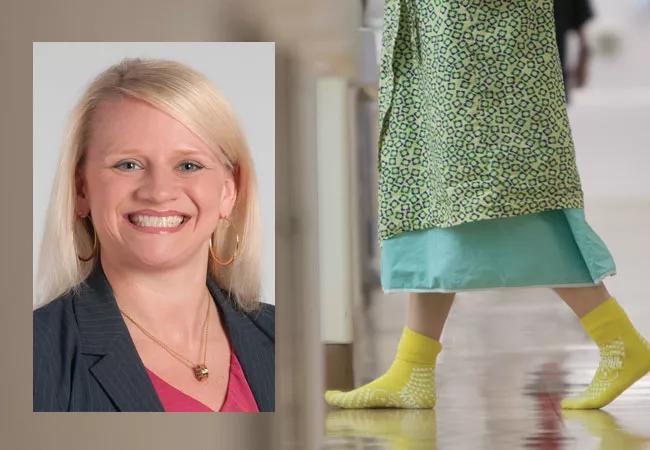
Image content: This image is available to view online.
View image online (https://assets.clevelandclinic.org/transform/9c0797b5-b336-44c4-9533-492252389757/18-NUR-4351-fox-nonSlipYellowSocks_650x450_jpg)
18-NUR-4351-fox-nonSlipYellowSocks_650x450
The 2018 ANCC National Magnet Conference was last week and the ever-important topics of nursing quality and patient safety couldn’t be more relevant. Viewed as the highest form of recognized nursing excellence, the Magnet Recognition Program® designates organizations worldwide that strategically align nursing goals to improve patient outcomes.
Advertisement
Cleveland Clinic is a non-profit academic medical center. Advertising on our site helps support our mission. We do not endorse non-Cleveland Clinic products or services. Policy
In this Q&A, Meredith Lahl-Foxx, MBA, MSN, APRN, PCNS-BC, PPCNP-BC, CPON, Associate Chief Nursing Officer of Advanced Practice Nursing and Nursing Quality & Practice, shares a few thoughts on how nurse leaders can help nursing caregivers continually improve care quality and patient safety.
Q: What is one of the most significant challenges to ensuring high-quality care and patient safety?
A: Everything the nurse does is centered on keeping patients safe and meeting care goals. From the moment patients are admitted, nurses and other caregivers are preparing them for discharge. They continuously provide patients and their families with highly important safety information, such as fall prevention, skin care, medication side effects and expectations for tests and procedures.
However, for many patients, these tasks are sophisticated and unfamiliar. To improve care and safety, nurse leaders need to support nurses in critically thinking while performing complex tasks. Throughout every shift, we want nurses to continuously ask themselves questions like: ‘What is the worst thing that could happen to my patient and how can I prevent that from happening?’ and ‘What are the implications of my nursing tasks on the patient’s outcome?’
Q: What specifically can nurse leaders do to help nurses combine daily tasks and critical thinking?
A: Nurses need to think “out loud” and review their plan with their patients, families and colleagues. I would also recommend that nurse leaders support all nurses being involved in unit-based Shared Governance. Through Shared Governance, nursing caregivers collaborate to solve problems at the unit/clinic level. They think critically and creatively, continuously formulating ideas for making patient care better and safer.
Advertisement
At Cleveland Clinic, our unit-based Shared Governance councils focus on quality, safety and patient experience. The ideas and results generated are then shared throughout the hospital and enterprise levels, which allows nurses to discuss and share their successes, opportunities and best practices on a grander scale. For 12 years, Cleveland Clinic has hosted a ‘Shared Governance Day’ that includes presentations on current relevant topics, enterprise council updates, and notable unit/clinic-based poster presentations. From this, our nurses have experienced tremendous growth, maturity and professionalism. Quality and safety are improving and many nurses are sharing their projects and posters at national conferences.
Q: What are some of the most important quality and safety topics nurse leaders should be focusing on today?
A: Currently, some of the most important and relevant topics in quality and patient safety are:
Advertisement
The bottom line is “do no harm” rings true for nurses all day, every day. All nurses want to provide high quality care and keep their patients safe – and nurse leaders can help achieve this level of excellence for every patient encounter by providing the tools and resources needed to help nursing caregivers succeed.
Advertisement
Advertisement

Nurses play key role in comprehensive lifetime treatment program
Customized bots improve speed, efficiency by streamlining daily clinical, clerical tasks
Nurses play pivotal role in patients’ ability to recover in the comfort of their own homes
New protocol reduces costs, increases patient and caregiver satisfaction

Advocating for patient safety is imperative in fast-paced surgical settings

M-Power program improves the perinatal experience for people who have survived abuse

Advice for those pursuing a WOC nursing career

Veteran nurse shares his experience as a caregiver and community volunteer
 Search