Locations:





Cleveland Clinic-developed tool guides referrals and predicts mortality
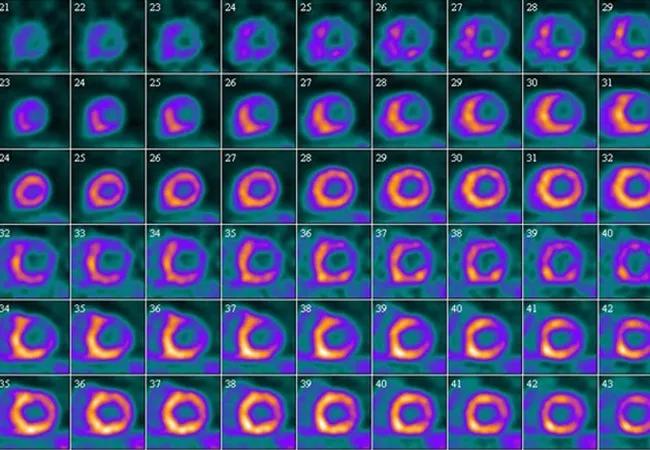
Image content: This image is available to view online.
View image online (https://assets.clevelandclinic.org/transform/b263275f-67dd-4b5c-930c-1e8a1bc62b6f/19-HRT-6065-SPECT-MPI-650x450_jpg)
19-HRT-6065-SPECT-MPI-650×450
A novel risk classification scheme for single-photon emission computed tomography myocardial perfusion imaging (SPECT-MPI) studies can predict mortality and successfully guide referral for revascularization and angiography, according to a recent prospective study of the Cleveland Clinic-developed tool. Researchers presented the appropriate use criteria (AUC)-derived scheme and study results at the American Heart Association’s 2019 Scientific Sessions.
Advertisement
Cleveland Clinic is a non-profit academic medical center. Advertising on our site helps support our mission. We do not endorse non-Cleveland Clinic products or services. Policy
The new risk tool incorporates the amount of myocardium at risk, the presence of scar, ventricular function and response of the ventricle to stress. The score is incremental rather than binary (ischemia/no ischemia) and uses various thresholds to confer risk.
“We developed this holistic tool specifically to avoid overusing these tests,” says senior investigator Wael Jaber, MD, a cardiologist in Cleveland Clinic’s Section of Cardiovascular Imaging, “and to ensure that the stress test is reported in a way that’s useful for making decisions about referral to either revascularization or medical therapy.”
The classification scheme arises amid a multiyear effort from the American Board of Internal Medicine called “Choosing Wisely,” a national campaign to avoid unnecessary tests across all areas of internal medicine. The American Society of Nuclear Cardiology (ASNC) published AUC in 2009 for SPECT-MPI, as well as a simplified list of five dos and don’ts as part of the Choosing Wisely campaign launch. Generally, the criteria exclude routine testing, general screening and testing in low-risk patients.
“We are seeing an overall downward trend in the use of these tests as a result, but we need to ensure that we are selecting patients according to a risk paradigm that makes sense,” says Dr. Jaber. “Until our study, the AUC for SPECT-MPI had not been tested in this clinical practice setting.”
The research team conducted a prospective study of patients who underwent SPECT-MPI at Cleveland Clinic from 2015 to 2017. They used a proprietary schema to stratify patients for scan risk — low, intermediate, high or indeterminate — and then assessed whether patients were referred for revascularization and angiography within 90 days of the study. They also tracked mortality.
Advertisement
The study captured 12,799 patients with a median age of 67 years. Exercise studies were performed in 37.2% of patients.
Using the novel classification scheme, patients were stratified into risk groups as follows: high risk, 5.2%; intermediate risk, 9.9%; low risk, 83.6%; and indeterminate risk, 1.3%. Compared with patients of low/indeterminate risk, patients with intermediate/high risk were referred more frequently for revascularization (P < 0.001) and angiography (P < 0.001), even after adjusting for the presence of ischemia or scar (hazard ratio = 1.74 [95% CI, 1.52-1.97]; P < 0.001).
At mean follow-up of 2.3 years, mortality tracked with risk classification, increasing incrementally from 4.1% in low-risk patients to 10.4% in high-risk patients (P < 0.001). Differences in findings for pharmacologic versus exercise SPECT-MPI were not significant.
“Interestingly,” says Dr. Jaber, “doctors referring these patients for stress tests, without knowing the intent of this project, respected the results of the test and risk classification and rarely referred patients for invasive testing if they were deemed low-risk.”
Current strategies base referral decisions on clinical data and noninvasive testing coupled with clinical judgment. This new classification scheme incorporates all known risk factors into a proprietary score to provide an evidence-based tool for making referral decisions.
“Currently, we use this tool across all Cleveland Clinic campuses,” says Dr. Jaber, who notes that commercialization of the tool is being explored. “It has allowed us to standardize how we manage patients with stable ischemic heart disease undergoing stress testing.”
Advertisement
He points out that the scheme serves as an effective decision-making tool that aligns with the Choosing Wisely campaign’s goal to reserve invasive procedures for patients with high-risk test results. “Our prospective data show that this tool works and can be used widely in practice,” he observes.
“This tool represents an important effort to identify high-risk patients with stable coronary artery disease using noninvasive testing,” adds Cleveland Clinic Cardiovascular Medicine Chair Samir Kapadia, MD, who served as a study coinvestigator. “It promises to be particularly relevant when clinicians want to implement results of the ISCHEMIA trial in practice.”
Advertisement
Advertisement
A sampling of outcome and volume data from our Heart & Vascular Institute
Concomitant AF ablation and LAA occlusion strongly endorsed during elective heart surgery

Large retrospective study supports its addition to BAV repair toolbox at expert centers
Young age, solid tumor, high uptake on PET and KRAS mutation signal risk, suggest need for lobectomy
Surprise findings argue for caution about testosterone use in men at risk for fracture
Residual AR related to severe preoperative AR increases risk of progression, need for reoperation

Findings support emphasis on markers of frailty related to, but not dependent on, age
Provides option for patients previously deemed anatomically unsuitable
 Search