Locations:





Two better than one when caring for high-acuity patients
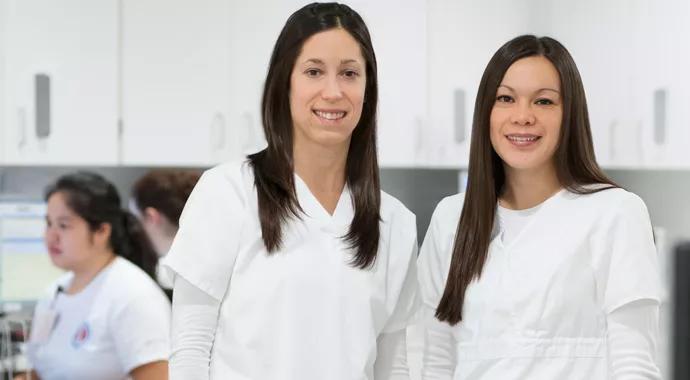
Image content: This image is available to view online.
View image online (https://assets.clevelandclinic.org/transform/d5d6620c-50c8-4ac6-a913-3d010d5182d8/co-charge-nurses-690-x-380_jpg)
co-charge-nurses-690-x-380
One January day, Cleveland Clinic’s echocardiography laboratory was flooded with crises.
Advertisement
Cleveland Clinic is a non-profit academic medical center. Advertising on our site helps support our mission. We do not endorse non-Cleveland Clinic products or services. Policy
Charge nurse Joanna Trivisonno, BSN, RN, and her team of nurses were already juggling daily responsibilities, preparing patients for procedures in the echo lab and helping conduct cardiology studies at patient bedsides around the hospital. Trivisonno was stationed in the echo lab’s recovery room, managing recovering patients, answering the frequently ringing telephone, dealing with changing procedure schedules and more. Suddenly, one patient’s blood pressure began to drop. Two others began having complications from sedation.
It was more than Trivisonno and her medical assistant could manage. That’s when Trivisonno turned to Melissa Hecker, BSN, RN, a “co-charge” nurse assigned to her that day.
“Having a co-charge nurse is like having a second brain and an extra set of hands,” says Trivisonno. “With a co-charge, I can do more to ensure patient safety and improve work flow and efficiency.”
Two leaders make unit run smoother
The echo lab has been operating with charge and co-charge nurses for more than a year. The duo-charge concept was suggested by former echo lab nurse Kirk Scheckel, RN. Nurses in the unit liked the idea and pilot tested it for several months before the charge and co-charge nurse roles became standard practice.
Charge nurses were surveyed about the unit’s safety and work environment both before and after adding a co-charge nurse. Results of the latter survey showed an approximately 80 percent improvement in charge nurses’ ability to maintain patient safety and perform quality work.
Advertisement
“It’s safer for our patients — many of whom are high-acuity, post-op patients — when there are two nurses on hand with seasoned critical-thinking and assessment skills,” says Trivisonno. “Now, I don’t need to worry about a patient needing me while I’m handling a phone call or doing something else to manage the unit.”
In addition, the latter survey showed a 136 percent improvement in fostering a stress-free work environment, which benefits patients as well as staff.
How it works
Cleveland Clinic’s echo lab has nine nurses who serve on rotating schedules. Four rotate as the charge and co-charge nurses.
The charge nurse directs the co-charge nurse, who works alongside the charge nurse and fills in when the charge nurse is away from the unit; on lunch break for example. Because only trained charge nurses fill either role, two experienced leaders are always on duty.
“The co-charge nurse knows what it’s like to be a charge nurse, so the person in this role often knows what the charge nurse is thinking and what the next steps should be,” says Trivisonno.
“When I’m in charge, having a co-charge nurse is extremely helpful,” says Hecker. “The co-charge nurse supports me, offering input. I’m never alone when I need to make decisions. When I’m the co-charge, I feel great satisfaction supporting my charge nurse, working as a team.”
They agree that the co-charge nurse concept may benefit other hectic nursing environments where patient safety is top priority.
“It could be valuable to have charge and co-charge nurses covering other units with prep and recovery areas, particularly where patients are recovering from sedation,” says Hecker.
Advertisement
Advertisement

Nurses play key role in comprehensive lifetime treatment program
Customized bots improve speed, efficiency by streamlining daily clinical, clerical tasks
Nurses play pivotal role in patients’ ability to recover in the comfort of their own homes
New protocol reduces costs, increases patient and caregiver satisfaction
Advocating for patient safety is imperative in fast-paced surgical settings
M-Power program improves the perinatal experience for people who have survived abuse

Advice for those pursuing a WOC nursing career

Veteran nurse shares his experience as a caregiver and community volunteer
 Search